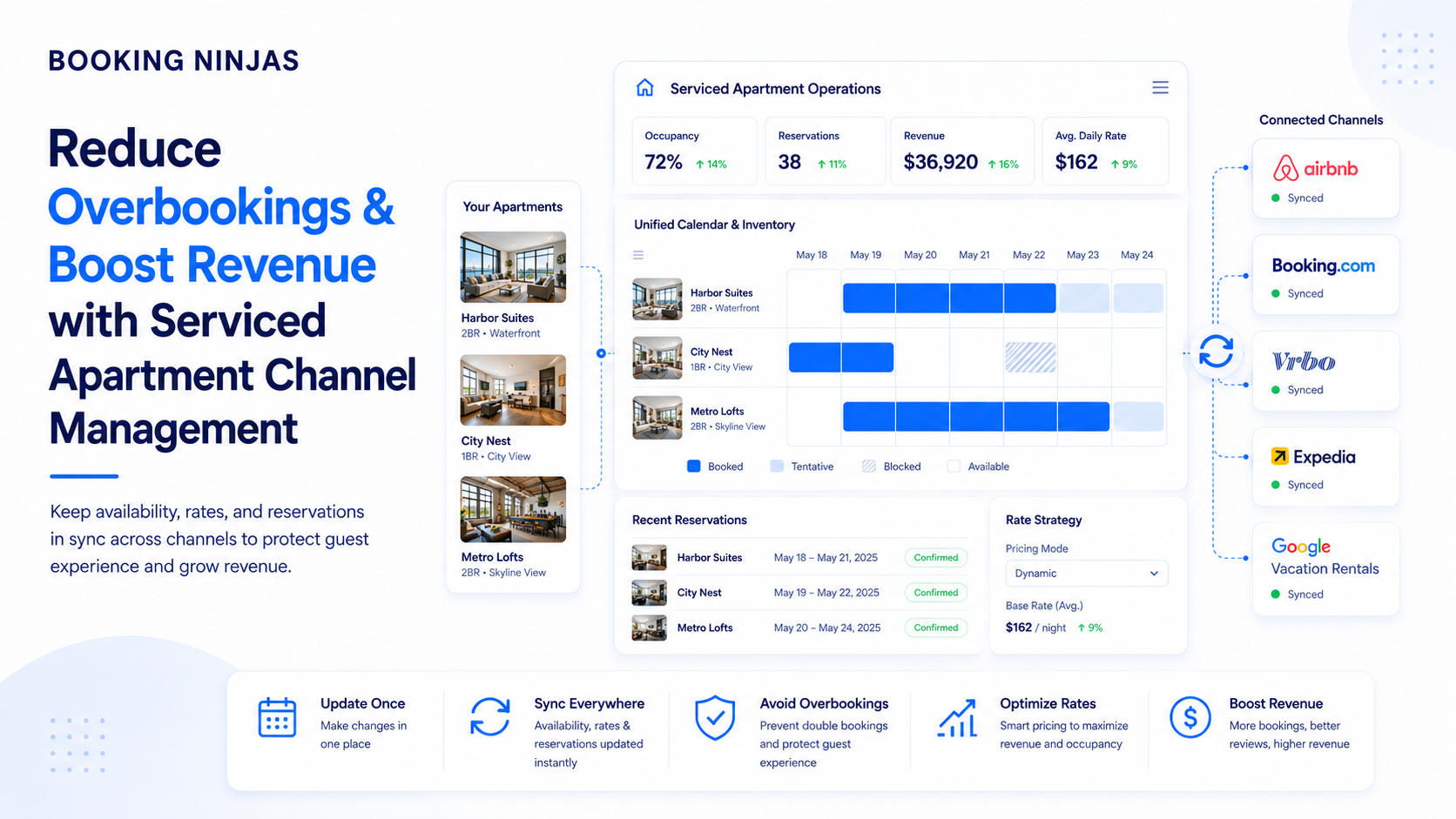
Serviced apartment distribution becomes more complex when the same units are sold across direct channels and multiple online booking platforms while operators also manage short stays, extended stays, extensions, changing rates, and availability.
Why is serviced apartment distribution unusually complex?
Serviced apartments combine characteristics of hospitality and residential operations. One unit may be available for short stays, another may be occupied for several weeks, and an existing guest may extend a reservation that changes future availability.
Operators may also manage several apartment types, buildings, or locations while distributing selected inventory through OTAs and direct booking channels.
- Unit-level rather than only room-type inventory
- Short, medium, and extended stays
- Stay extensions that affect future availability
- Different rates across dates and stay lengths
- Multiple properties or apartment locations
- Direct and third-party booking channels
Booking Ninjas' Serviced Apartment Management solution is designed around unit-based inventory, mixed stay durations, reservations, billing, housekeeping, and multi-property operations.
What does a channel manager do for serviced apartments?
A channel manager acts as the distribution layer between the property's booking environment and supported external booking channels.
Rather than requiring staff to manually update the same apartment inventory on every platform, the channel manager exchanges availability, rates, restrictions, and reservation information according to the configured connection.
Booking Ninjas' Channel Manager is built to connect rates, availability, and reservations across supported distribution channels while keeping that activity within the broader Salesforce-native booking environment.
How should availability move across the distribution workflow?
The operating system maintains the apartments, units, dates, restrictions, and available inventory.
The channel manager sends relevant availability and rate information to connected booking channels.
A booking from a connected channel enters the reservation environment with its channel and stay context.
The affected inventory can then be updated across other connected channels according to the synchronization setup.
What is the difference between the PMS and the channel manager?
The two systems solve related but different problems.
| Area | Property management system | Channel manager |
|---|---|---|
| Inventory | Maintains the property's operational unit and availability records. | Distributes available inventory to connected booking channels. |
| Reservations | Maintains the booking and wider stay record. | Transfers reservations from supported external channels into the booking environment. |
| Rates | Maintains the relevant pricing and rate rules. | Distributes applicable rates to connected channels. |
| Stay operations | Connects bookings with billing, housekeeping, guest activity, extensions, and other operational processes. | Does not replace the wider property operating workflow. |
| Distribution | Provides the inventory and reservation foundation. | Connects that foundation with external sales channels. |
This is why channel management works best as part of the property operating architecture rather than as an isolated calendar-sync tool.
Why is availability the most important record to keep aligned?
Every booking decision depends on whether an apartment can actually be sold for the requested dates.
Booking Ninjas' Availability Management provides the underlying visibility into reservable inventory, capacity, dates, and restrictions.
The channel manager can then distribute the relevant availability to connected booking platforms.
New reservations change future availability
When a connected reservation is accepted, the corresponding unit or inventory must no longer appear available for conflicting dates elsewhere.
Extensions can change availability too
Serviced apartments add another complication: an existing guest may extend a stay. That extension can affect dates that were previously available for sale and therefore needs to be reflected throughout the connected booking environment.
Cancellations reopen inventory
A cancellation may make previously occupied dates available again, subject to the property's rules and the behavior of the connected channel.
Can a channel manager prevent double bookings?
Synchronizing availability and reservations across connected channels can substantially reduce the risk of conflicting bookings compared with manually maintaining separate calendars.
It should not be treated as an absolute guarantee that conflicts can never occur. Results depend on the external channel, integration, synchronization behavior, mapping, configuration, connectivity, and exception handling.
- Accurate unit and inventory mapping
- Reliable reservation synchronization
- Correct availability rules
- Appropriate restrictions and rate plans
- Monitoring of integration failures
- Staff procedures for exceptions
How should rates connect to serviced apartment distribution?
Serviced apartment pricing can vary by unit, season, stay length, occupancy strategy, promotion, or other configured rules.
A rate should not have to be recreated independently on every booking platform whenever the operator changes its pricing strategy.
Booking Ninjas' Rate Management provides the pricing layer, while the Channel Manager can distribute applicable rate information to supported channels.
Not every channel has to use identical pricing
Distribution strategy may include different rate plans, restrictions, promotions, or commercial arrangements depending on the channel. The important requirement is that pricing rules are intentional and the system maintains the correct relationship between the rate and the inventory being distributed.
What happens after an OTA reservation enters the PMS?
Distribution is only the beginning of the operating process.
Once the reservation enters Reservation Management , it becomes part of the wider serviced apartment operation.
Depending on the property and implementation, that reservation may need to connect with:
- The guest or customer record
- The apartment or unit
- Arrival and departure dates
- Billing and payment activity
- Housekeeping and turnover
- Guest communication and requests
- Stay extensions or modifications
- Reporting and operational workflows
This is the difference between simply synchronizing calendars and connecting distribution to property operations.
How do short and extended stays affect channel management?
Serviced apartment operators may sell some inventory like a hotel while also accommodating guests who stay for weeks or longer.
An extended reservation blocks a larger section of the availability calendar. A change to that stay can therefore affect a significant number of future bookable dates.
The distribution architecture needs to respect the same stay record that the property team is using operationally rather than maintaining a separate OTA calendar that does not understand the extended stay.
What changes when serviced apartments operate across multiple locations?
Multi-property portfolios increase the number of units, rates, mappings, channels, and booking relationships that need to remain organized.
A centralized platform can give operators a shared view across properties while still preserving the unit, property, rate, and reservation relationships required for each location.
Booking Ninjas' Serviced Apartment solution supports single and multi-property serviced apartment operations, while the Channel Manager supports distribution across multiple properties and units.
Should serviced apartments use OTAs and direct bookings together?
They can. Different booking channels can play different roles in a serviced apartment distribution strategy.
The operational challenge is making sure a unit sold through one source affects the inventory available through the others.
Operators can then evaluate the contribution of different channels using factors such as reservation volume, length of stay, revenue, cancellations, distribution cost, and other metrics relevant to their strategy.
Channel performance should be interpreted in context rather than assuming either direct bookings or OTAs are universally better.
What should serviced apartment operators measure?
The purpose of distribution reporting is to understand how inventory is being sold and where operational problems are occurring.
- Reservations by booking source
- Occupancy by unit or property
- Average length of stay
- Revenue by relevant channel
- Cancellation patterns
- Booking conflicts or synchronization exceptions
- Direct versus third-party reservation mix
- Availability and inventory utilization
Booking Ninjas' Insights capabilities can provide reporting and decision support around the operational, reservation, and financial information available within the platform.
These metrics can support distribution decisions but do not guarantee higher occupancy, revenue, or profitability.
What should operators check before connecting booking channels?
- Define the inventory model. Confirm how buildings, apartments, units, categories, and reservable inventory are represented.
- Map inventory carefully. Make sure the correct units or unit types correspond to the correct listings on each connected channel.
- Define rate and restriction rules. Establish which rates, minimum stays, restrictions, or other distribution rules should apply.
- Test reservation flow. Confirm that bookings, modifications, and cancellations move through the expected workflow.
- Test availability updates. Verify that changes to bookings and stays are reflected correctly across the connected distribution environment.
- Define an exception process. Decide how staff will respond when a connection fails, data does not match, or manual intervention is required.
What if a serviced apartment operator uses other distribution systems?
Channel management does not exist in isolation. Operators may also use booking engines, revenue systems, payment providers, accounting applications, CRM tools, or other specialist technology.
Booking Ninjas supports external system connections through its Integrations layer.
The exact connection depends on the external platform, available interfaces, required data flows, ownership of each record, and implementation scope.
Why does Salesforce-native channel management matter?
Distribution creates operational data: reservations, guest records, rates, revenue, availability changes, and booking-source information.
Booking Ninjas runs its booking and operational applications on Salesforce. This means channel activity can remain connected to the broader reservation, customer, financial, workflow, and reporting environment rather than existing only in a separate distribution dashboard.
The Salesforce-native foundation provides the broader data, permission, workflow, reporting, and integration architecture behind those operational relationships.
How does Booking Ninjas connect serviced apartment distribution?
Booking Ninjas combines serviced apartment operations with a Salesforce-native booking and distribution environment.
Operators can connect unit-based inventory, short and extended stays, reservations, rates, availability, billing, housekeeping, reporting, and supported distribution channels within the same broader operating architecture.
Manage units, short and extended stays, reservations, operations, billing, and multi-property portfolios.
Explore Serviced Apartments →Connect rates, availability, reservations, and supported distribution channels.
Explore Channel Manager →Maintain inventory, dates, capacity, and availability conditions behind distribution.
Explore Availability Management →Manage pricing rules and rate structures before distributing them to relevant booking channels.
Explore Rate Management →Connect incoming bookings with guests, units, stay dates, billing, and operations.
Explore Reservation Management →Keep booking and distribution records connected to Salesforce data, permissions, workflows, reporting, and integrations.
Explore Salesforce DNA →Frequently asked questions
What is a channel manager for serviced apartments?
A serviced apartment channel manager connects property inventory with supported booking channels so rates, availability, and reservations can be synchronized from a central booking environment.
What is the difference between a channel manager and a PMS?
A PMS manages the wider reservation and property operation, including stays, guest records, billing, housekeeping, and other workflows. A channel manager focuses on distributing rates and availability and exchanging reservations with supported external booking channels.
Can a channel manager prevent double bookings?
Synchronizing reservations and availability across connected channels can substantially reduce double-booking risk. Actual results depend on inventory mapping, configuration, synchronization behavior, external platforms, connectivity, and exception handling.
Can channel management support both short and extended stays?
Yes, where the underlying property system supports those stay models and the required inventory can be distributed through the connected channels. Booking Ninjas supports short and extended stays within its serviced apartment operating environment.
Can Booking Ninjas manage multiple serviced apartment locations?
Yes. Booking Ninjas supports multi-property serviced apartment operations and centralized management of units, reservations, availability, billing, and related operational records.
Is Booking Ninjas channel management built on Salesforce?
Yes. Booking Ninjas is a Salesforce-native platform for bookings and operations, allowing reservation, distribution, customer, financial, workflow, and reporting records to use the broader Salesforce platform foundation.
Connect distribution to the serviced apartment operation
Bring units, rates, availability, reservations, short and extended stays, reporting, and connected booking channels into one clearer Salesforce-native operating environment.