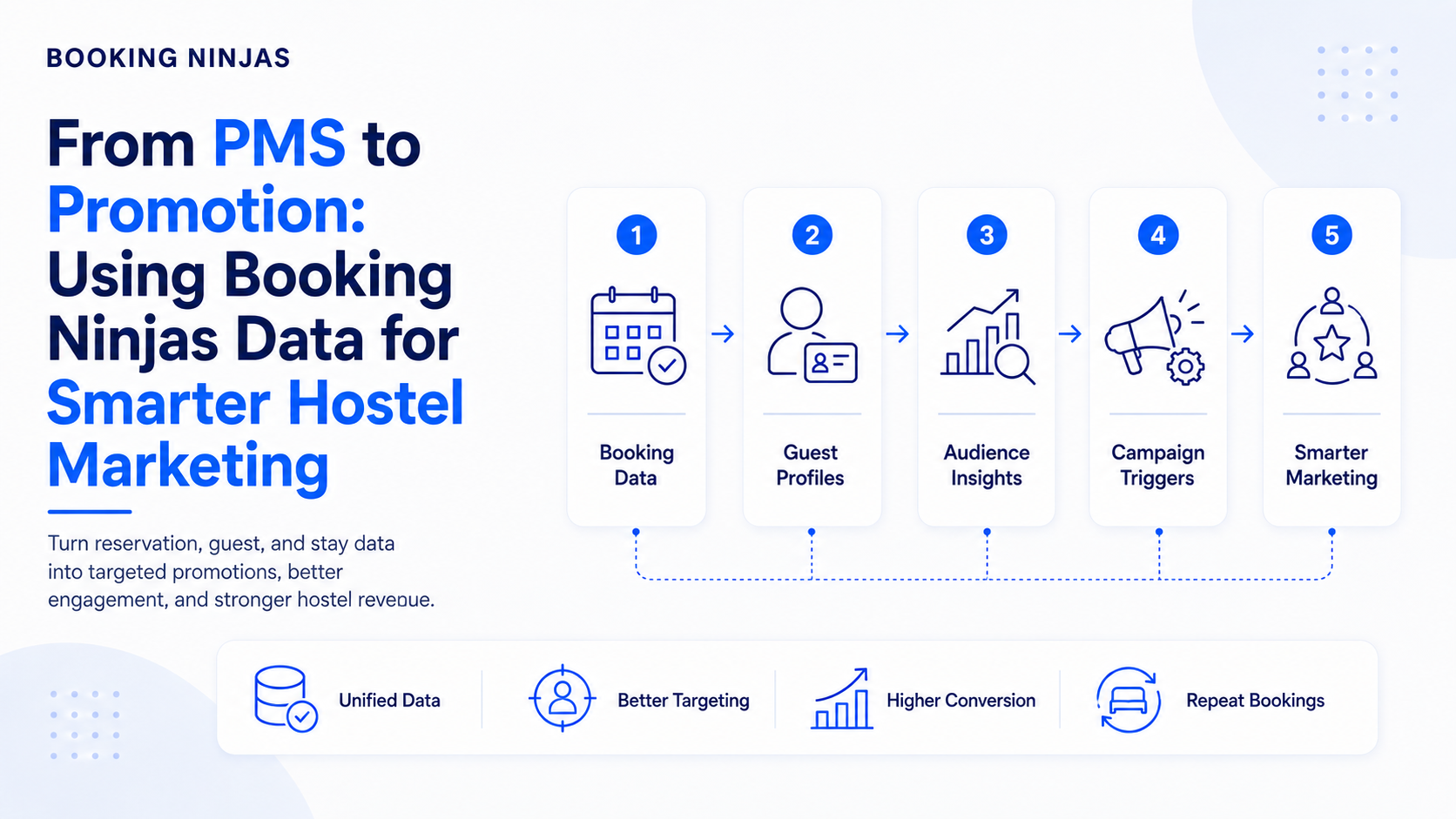
Hostel marketing becomes more useful when it starts with what guests actually do: how they book, how long they stay, which accommodation they choose, what they purchase, and whether they return.
What can hostel PMS data tell the marketing team?
A hostel operation continuously creates useful records around guests and stays. Reservations can show when someone booked, what they booked, the length of the stay, the booking source, and whether the guest has stayed before.
Billing and service records can add further context around purchases or other activity when that information is available and appropriate to use.
- Booking and stay history
- Dorm, room, or bed type
- Length and timing of stay
- Booking source or channel
- Relevant payment or purchase activity
- Repeat-stay patterns
- Property or location
- Service or request history where appropriate
These records are useful because they describe actual operational behavior rather than an assumed customer persona.
What is the role of the PMS, CRM, and marketing platform?
Marketing architecture becomes clearer when each system has a defined responsibility.
Records reservations, beds, stays, availability, payments, and other operational activity.
Maintains the broader guest or customer relationship across multiple interactions.
Manage campaigns, email, messaging, advertising, or other communication processes.
Measures operational and campaign performance against defined business questions.
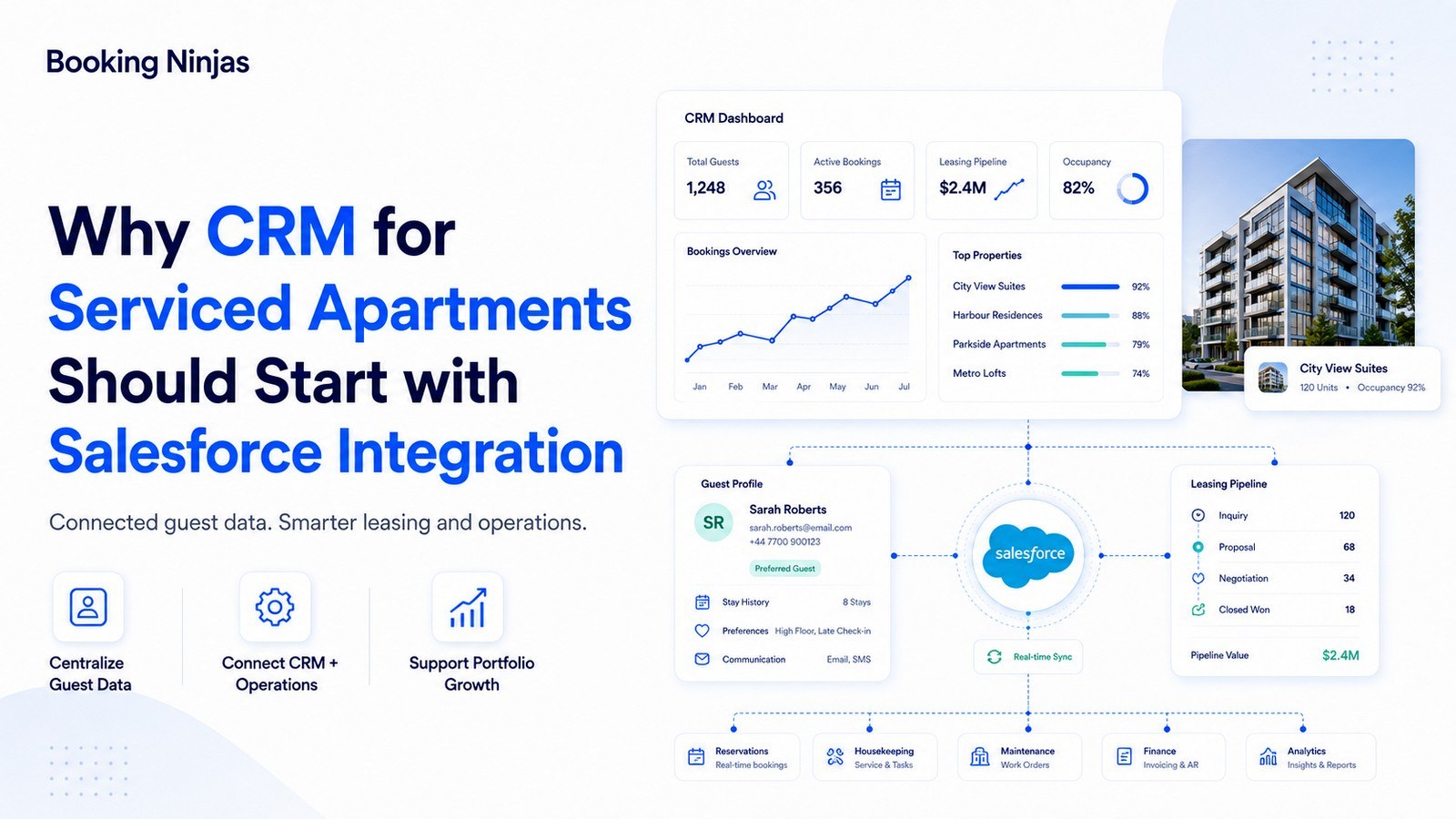
Booking Ninjas is a Salesforce-native platform for bookings and operations . This means guest and operational records can use the broader Salesforce platform foundation instead of treating CRM as a completely separate customer database.
What should be fixed before using PMS data for marketing?
Identify duplicate guest records
If the same person appears as several unrelated profiles, marketing and reporting can produce misleading results. Establish rules for identifying and managing duplicate or fragmented guest records.
Define the source of each field
Know which system owns the reservation, contact information, payment status, marketing consent, and other data used by downstream processes. Avoid maintaining several unofficial versions of the same information.
Separate operational data from marketing permission
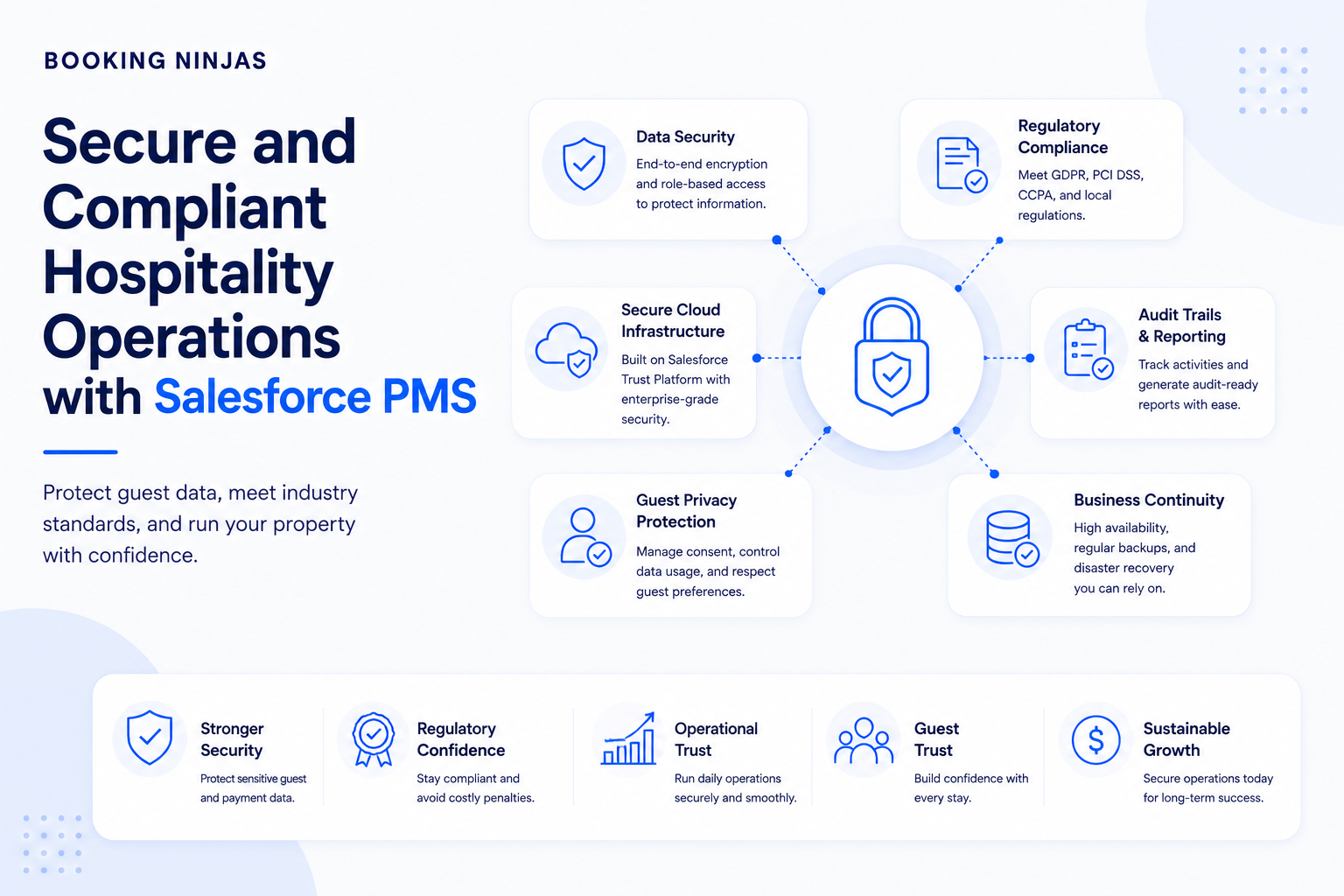
Having a guest's email address because they made a reservation does not automatically mean every use of that address is appropriate for marketing. Consent, communication preferences, purpose, retention, and applicable privacy requirements should be incorporated into the data model and marketing process.
How can hostel operators segment guests using operational data?
Useful segmentation starts with a business question. Instead of assigning broad labels to every guest, use data that has a clear relationship to the decision or campaign being planned.
| Business question | Relevant operational data | Possible segment |
|---|---|---|
| Who has stayed before? | Guest identity and completed reservation history. | First-time and returning guests |
| Who tends to stay longer? | Arrival and departure dates across completed stays. | Short-stay and extended-stay guests |
| What accommodation do guests choose? | Dorm, private room, bed, or other inventory category. | Guests grouped by previous accommodation choice |
| Where did reservations originate? | Direct, channel, walk-in, or other recorded booking source. | Guests grouped by acquisition source |
| Which properties have they used? | Property and reservation history. | Single-location or multi-location guests |
| Which additional services were used? | Relevant billing, payment, or service records. | Guests with recorded ancillary activity |
Segments should remain descriptive. A guest who once stayed for two weeks is not automatically a "digital nomad," and someone who booked a dorm bed is not necessarily always a budget traveler.
Why is reservation data central to hostel marketing insight?
Reservations establish much of the context around the guest's relationship with the property: booking dates, stay dates, inventory, rate, status, source, and history.
Booking Ninjas' Reservation Management keeps reservation records connected with the underlying guest and operational environment.
For hostels, this is particularly important because accommodation may involve individual beds, shared dormitories, private rooms, short stays, extended stays, and frequent guest turnover.
How can booking-source data inform marketing decisions?
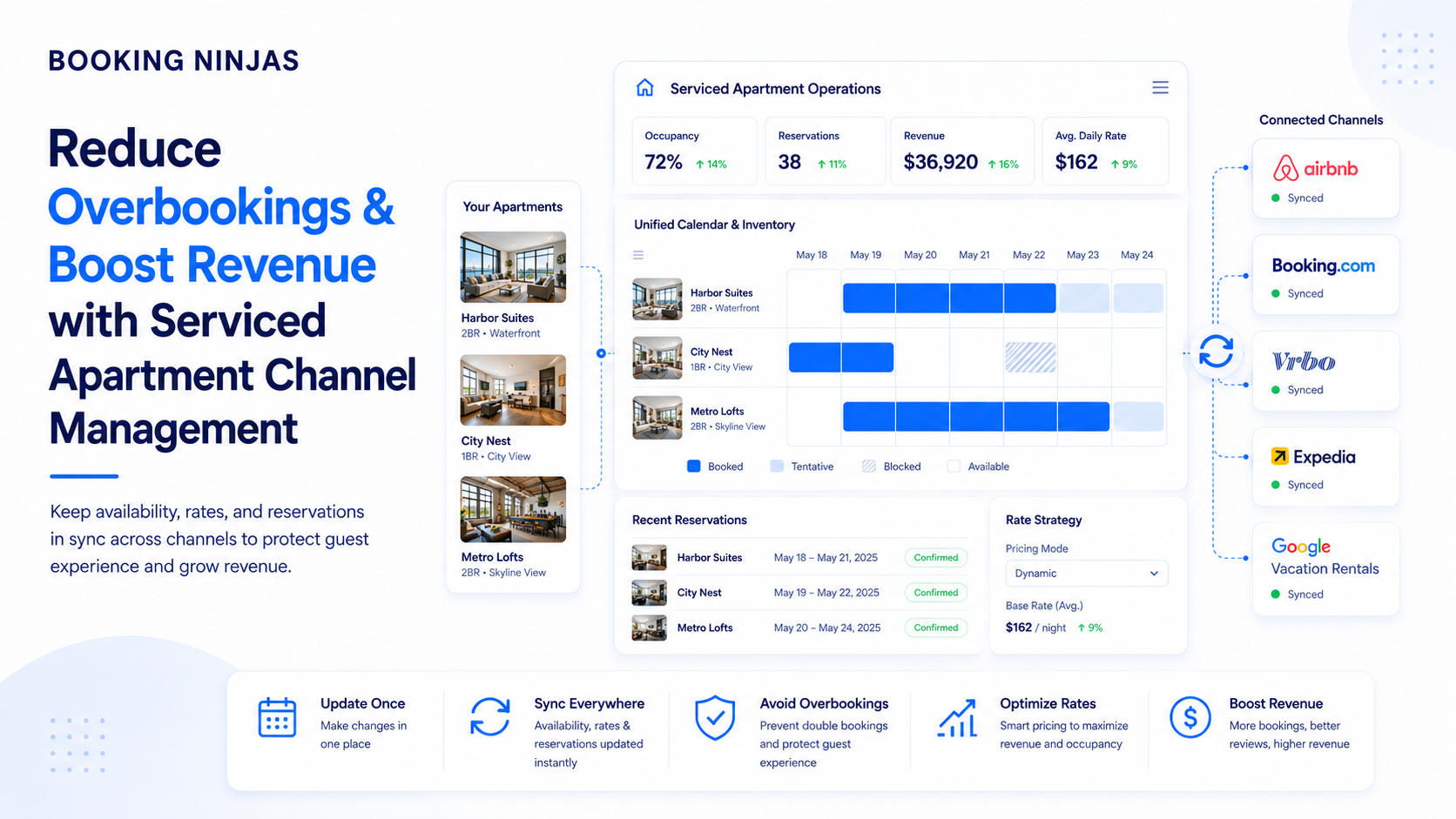
Operators can compare how reservations reach the property through direct and connected distribution channels where that source information is available.
The purpose is not simply to decide that one channel is "better." Different sources can produce different booking patterns, costs, cancellation behavior, lengths of stay, or demand at different points in the year.
Booking Ninjas' Channel Manager sits within the distribution side of the booking environment, helping connect supported channel activity with availability and reservations.
How can PMS data support the guest communication lifecycle?
The most useful lifecycle communication starts from operational events rather than arbitrary mailing dates.
Before arrival
Reservation dates and status can provide context for confirmations, arrival information, property instructions, or relevant pre-arrival communication.
During the stay
Current stay information can help the operation provide relevant service information or make appropriate services available through the guest experience.
After departure
Completed-stay history can become part of the longer-term customer relationship, subject to the organization's communication rules, preferences, and marketing permissions.
Dedicated email, SMS, marketing automation, or campaign systems can remain responsible for marketing communication. The PMS or CRM provides context; the communication platform delivers the campaign.
Where do add-ons and ancillary services fit?
Some hostels sell more than accommodation. Depending on the property, guests may have access to breakfast, lockers, laundry, transfers, tours, events, or other optional services.
When those services are offered, the important data relationship is between the guest, the reservation, the service, and the resulting charge or payment.
Booking Ninjas' Billing & Payment capabilities can keep relevant financial activity connected to the operational records that created it.
The Guest Portal can also provide a guest-facing environment for bookings, payments, account visibility, and service requests.
What should hostel operators measure?
Start with metrics that answer a defined operational or marketing question rather than trying to turn every available field into a dashboard.
- Reservations by source
- Average length of stay
- First-time versus returning stays
- Accommodation-type demand
- Ancillary activity where recorded
- Booking and cancellation patterns
- Direct and channel reservation trends
- Property or location performance
Campaign-specific metrics such as email opens, clicks, advertising performance, or campaign conversion typically come from the marketing or analytics systems running those activities.
The useful connection is between campaign performance and the resulting operational outcome where reliable attribution is available.
Booking Ninjas' Insights capabilities provide reporting and decision support around operational, customer, and financial information available within the platform.
Why should operators be careful with marketing attribution?
A reservation does not always have one simple cause. A guest might discover a hostel through social media, compare it on an OTA, visit the hostel website, and book later through another source.
Promo codes, campaign parameters, booking sources, and CRM activity can provide useful evidence where they are correctly captured, but none should automatically be treated as a perfect explanation of why a booking occurred.
How should the PMS connect with marketing technology?
A hostel does not need to replace every specialist application to create a connected marketing operation.
Email platforms, SMS tools, advertising systems, analytics applications, reputation tools, and other marketing technology can remain part of the stack.
The architecture should define which records need to move, which platform owns each piece of information, how frequently information needs to update, and what consent or permission rules apply.
Booking Ninjas supports external system connections through its Integrations layer. The exact integration depends on the external application, its available interfaces, the required data flows, and implementation scope.
Why does Salesforce-native architecture matter here?
The traditional PMS-and-CRM problem is partly architectural. If the reservation system and CRM maintain separate versions of the guest, every useful marketing or customer workflow may depend on additional synchronization.
Booking Ninjas runs bookings and operations on Salesforce. That allows customer, reservation, financial, workflow, and other operational records to use the same broader platform foundation.
The Salesforce-native foundation can therefore reduce the separation between CRM context and hostel operations while still allowing specialist marketing systems to connect where appropriate.
How should a hostel start using PMS data for marketing?
- Choose one business question. Decide what you are trying to understand before building segments or campaigns.
- Identify the operational records required. Determine whether the answer depends on reservation history, channel, length of stay, property, payment, or another field.
- Check data quality and permissions. Confirm that the records are reliable and appropriate for the intended marketing use.
- Create a simple, evidence-based segment. Begin with one or two characteristics that can be clearly supported by actual data.
- Connect the appropriate communication tool. Let the CRM or marketing platform execute the campaign rather than forcing the PMS to perform every marketing function.
- Compare campaign and operational outcomes. Review what happened, identify limitations in attribution, and use the result to improve the next test.
How does Booking Ninjas connect hostel operations with customer data?
Booking Ninjas is a Salesforce-native platform for bookings and operations . Its Hospitality platform supports hostel operating requirements such as shared accommodation, bed-level inventory, reservations, guest records, payments, operations, and reporting.
This provides the operational data foundation. CRM, integrations, analytics, and external marketing applications can then use the relevant parts of that information according to the organization's architecture and communication policies.
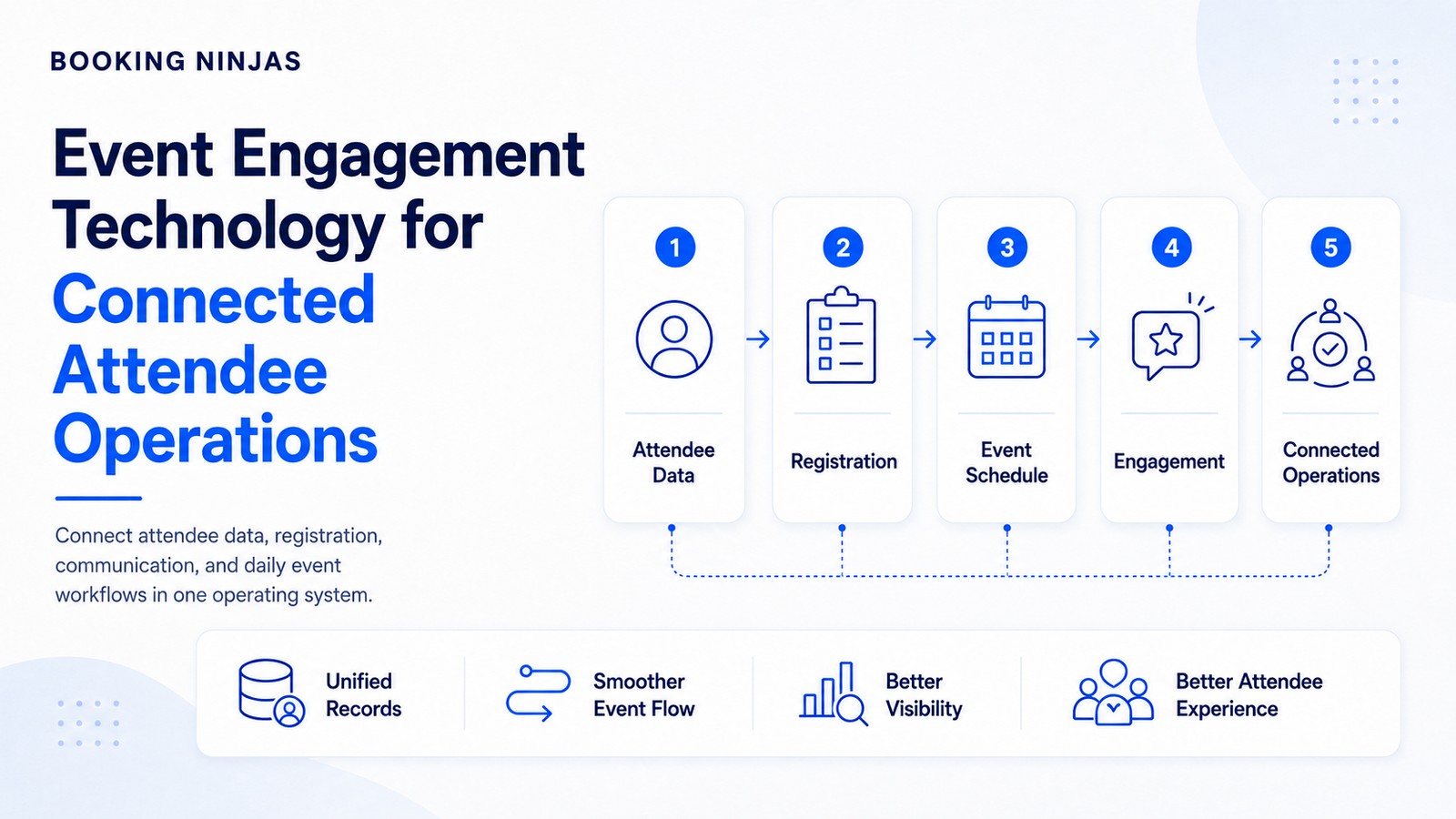
Connect hostel reservations, guests, payments, inventory, and daily operations.
Explore Hospitality →Keep guest, stay, source, inventory, dates, and booking history connected.
Explore Reservation Management →Connect bookings, payments, account visibility, and service interactions to the guest-facing experience.
Explore Guest Portal →Analyze operational, customer, booking, and financial information within the available data environment.
Explore Insights →Connect external communication, analytics, financial, and other specialist systems where required.
Explore Integrations →Keep customer and operational records on the broader Salesforce platform foundation.
Explore Salesforce DNA →Frequently asked questions
What hostel PMS data can be useful for marketing?
Useful data can include reservation history, stay dates, accommodation type, booking source, property, repeat stays, and relevant billing or service activity. Which fields should be used depends on the business question, data quality, permissions, and applicable privacy requirements.
Is a PMS the same as a marketing automation platform?
No. A PMS primarily manages bookings and property operations. Marketing automation platforms specialize in campaigns and communication. Connecting them can allow marketing processes to use relevant operational context without requiring the PMS to replace dedicated marketing tools.
Can PMS data be used to segment hostel guests?
Yes. Operators can create evidence-based segments using available information such as previous stays, length of stay, accommodation type, booking source, or location. Segments should reflect what the data actually shows rather than assumptions about the guest.
Does Booking Ninjas include hostel CRM data?
Booking Ninjas is built natively on Salesforce, so guest, reservation, financial, workflow, and other operational records can use the broader Salesforce platform foundation rather than relying on a completely separate external CRM database.
Can Booking Ninjas connect with external marketing tools?
Booking Ninjas supports integrations with external systems. The exact connection to an email, marketing, analytics, or other platform depends on the external system, available interfaces, required data flows, and implementation scope.
Connect hostel operations to the customer relationship
Bring guests, reservations, beds, payments, reporting, CRM context, and integrations into a clearer Salesforce-native operating environment.