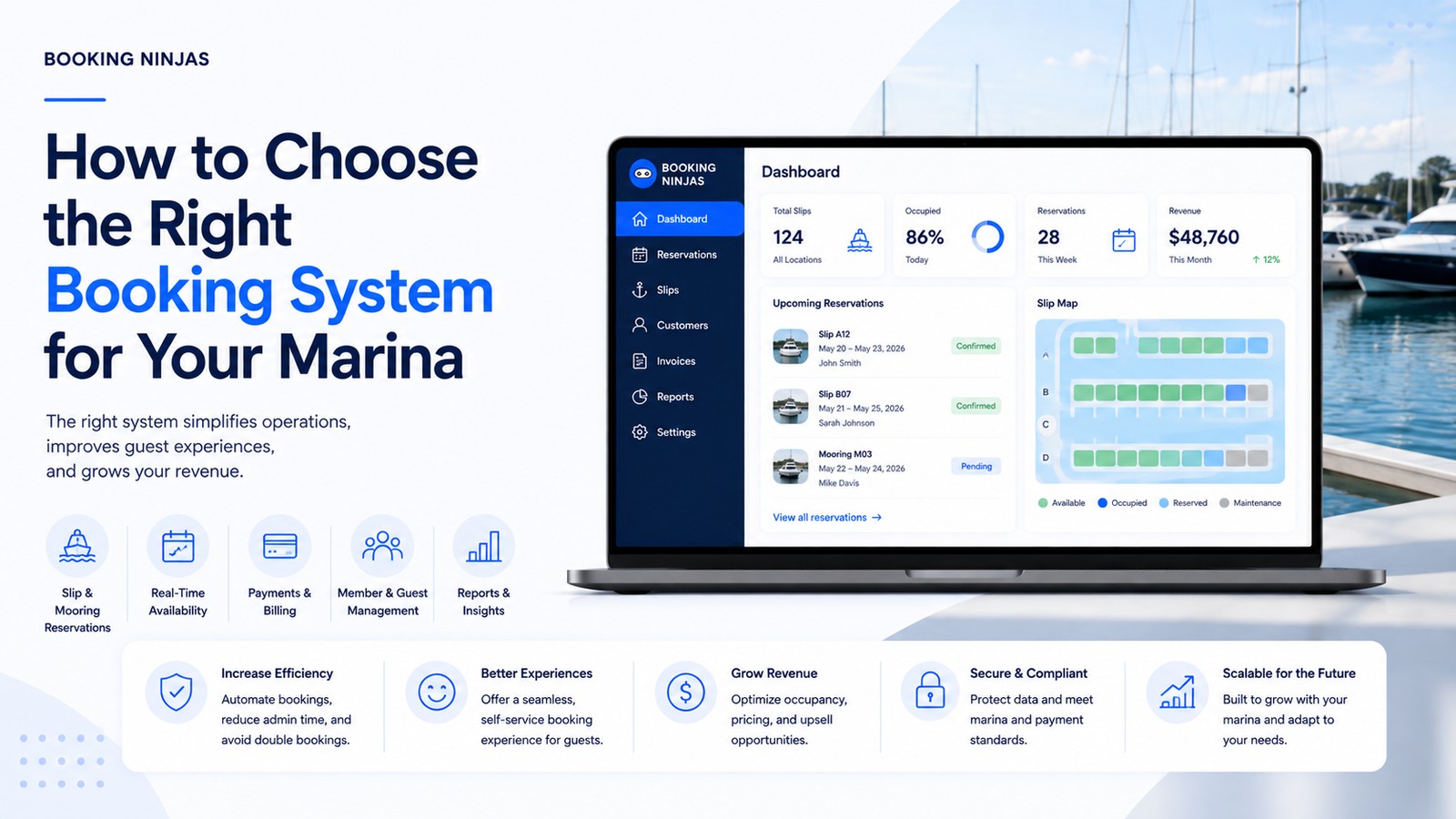
Choosing marina booking software is different from choosing a generic reservation calendar. A marina has to match vessels with suitable slips, manage transient and long-term use, maintain availability, collect different types of charges, coordinate arrivals and departures, and keep dock operations connected to the reservation.
That means the selection process should start with the way the marina actually operates—not with the longest software feature checklist.
Why does a marina need a specialized booking system?
A standard reservation system usually asks a relatively simple question: which unit is available for which dates?
A marina needs additional context before an assignment is practical.
- Slip or berth dimensions
- Vessel dimensions and characteristics
- Dock or marina location
- Transient versus long-term use
- Arrival and departure dates
- Utility or service requirements
- Occupancy and assignment status
- Applicable rates and fees
- Deposits or recurring charges
- Maintenance or operational restrictions
The booking system therefore needs to understand both availability and suitability.
What should a marina booking system connect?
Identify who is arriving and the vessel that needs a suitable slip or berth.
Determine which inventory is available and appropriate for the requested period.
Record the booking or assignment together with applicable rates, fees, deposits, and payment responsibilities.
Coordinate arrivals, services, maintenance, communication, departures, and future renewals.

Can the system model your slips, docks, and berths correctly?
Inventory structure should be one of the first things you test during software evaluation.
The system should be able to represent the marina at the level staff actually use when making assignments.
- Marina location
- Dock
- Slip or berth
- Slip type
- Relevant dimensions
- Capacity or suitability rules
- Availability status
- Operational restrictions
Booking Ninjas' Marina Management solution is built around slip-based inventory and provides visibility into slips, docks, berths, availability, occupancy, and assignments.
Does the booking workflow consider the vessel as well as the dates?
A marina reservation connects two types of records: the space being assigned and the vessel using it.
A booking workflow may therefore need to capture information such as the vessel, owner or boater, requested dates, and the attributes used by the marina to determine suitable placement.
The exact vessel and assignment fields depend on the marina's operating model, but the important design principle is consistent:
Can it handle both transient boaters and long-term slip holders?
One marina can operate several commercial relationships with the same physical inventory.
| Relationship | Reservation model | Financial and operational context |
|---|---|---|
| Transient stay | Defined arrival and departure period. | Short-term rate, applicable fees, arrival information, payment, and departure. |
| Monthly use | Longer assignment with an ongoing relationship. | Recurring charges, services, account history, and changes during the term. |
| Seasonal assignment | Slip committed for a defined operating season. | Contract or policy terms, deposits, scheduled charges, services, and possible renewal. |
| Long-term slip holder | Continuing relationship associated with a particular marina or slip arrangement. | Recurring billing, service history, vessel records, communication, and renewal or reassignment. |
The system should support these models without forcing staff to maintain separate customer, slip, or payment records simply because the booking duration changes.
What is the difference between a marina reservation and a slip assignment?
A reservation represents the booking relationship for a particular period. A slip assignment identifies where the vessel will actually be placed.
In simple situations, both decisions may happen at the same time. More complex marina workflows may need to keep them conceptually separate.
For example, staff may accept a future reservation before the final slip is confirmed, or reassign a vessel while preserving the wider booking relationship.
A flexible system should allow the marina's workflow to reflect these operational differences rather than making staff rebuild the reservation every time a placement changes.
How should marina availability work?
Availability should reflect whether the relevant slip can actually be allocated for the requested period.
Booking Ninjas' Availability Management connects reservable inventory with dates, restrictions, capacity, reservations, and operational availability.
For a marina, the availability model can then be applied around slip and berth inventory according to the configured operating rules.
Reservations should affect future availability
Once inventory is committed for a particular period, overlapping availability should reflect that commitment.
Cancellations should be handled deliberately
A canceled reservation may release a slip, but any applicable operational restrictions, holds, or reassignment rules should still be considered.
Maintenance can affect availability too
A physically empty slip may still be temporarily unavailable if maintenance or other operational work affects its use.
Should every marina reservation be confirmed automatically?
Not necessarily.
Different reservation types can justify different levels of customer self-service, automated rules, and staff review.
| Booking model | How it works | When it may be useful |
|---|---|---|
| Staff-managed | Marina staff review the request and create or confirm the booking internally. | Complex placements, exceptions, unusual vessels, or negotiated arrangements. |
| Request and review | The boater submits information and staff review it before confirmation. | When customer convenience is useful but suitability still needs validation. |
| Self-service booking | Eligible inventory can be booked according to predefined rules. | Straightforward reservation scenarios with reliable availability and booking rules. |
Booking Ninjas' Reservation Management provides the reservation record and workflow layer around availability, status, rules, changes, and operational records.
Can the system handle different marina billing models?
The financial relationship for a one-night transient booking can be very different from a seasonal or long-term slip arrangement.
Depending on the marina, charges may include:
- Nightly slip charges
- Monthly charges
- Seasonal charges
- Deposits
- Utility charges
- Marina services
- Additional fees
- Refunds or adjustments
Booking Ninjas' Billing & Payment layer connects billing and payment activity with the appropriate customer and operating records.
For ongoing relationships, Recurring Billing can support monthly, seasonal, annual, or other configured billing cycles.
Does the booking system connect with marina operations?
A reservation does not end when it is confirmed.
The booking creates operational activity around the vessel and slip. Depending on the marina, that may include:
- Arrival preparation
- Slip assignment
- Boater communication
- Service requests
- Utility-related activity
- Dock maintenance
- Incident or issue follow-up
- Departure and future renewal
Booking Ninjas' Work Order Management provides structured records for maintenance, service, assignments, priorities, status, and operational follow-up.
This allows the booking and operations layers to remain related without pretending the reservation itself performs the maintenance work.
Should transient and long-term boaters use the same customer record?
The underlying customer relationship should remain identifiable even when the commercial relationship changes.
A boater might first visit as a transient customer and later become a seasonal or long-term slip holder. Maintaining connected customer, vessel, reservation, billing, and service history gives staff a clearer view of that relationship.
What changes is the workflow around the customer:
- Booking duration
- Slip assignment
- Billing frequency
- Documents or policies
- Communication cadence
- Renewal process
What should multi-marina operators look for?
Managing several marina locations creates another layer of complexity.
Leadership may want centralized visibility while each location retains its own docks, slips, prices, customers, operational rules, and assignments.
A useful multi-location system should make it possible to review information by:
- Marina
- Dock
- Slip or berth
- Reservation type
- Occupancy
- Boater or account
- Billing activity
- Operational status
Booking Ninjas supports single- and multi-marina operations within the same broader Salesforce-native platform.
Which integrations should you evaluate?
Marina software rarely exists completely on its own. Before choosing a platform, identify which external systems need to exchange data with the booking environment.
- Payment processors
- Accounting systems
- ERP systems
- Access systems
- Communication platforms
- Existing CRM environments
- External portals
- Other marina-specific systems
Booking Ninjas' Integrations layer supports connections with external systems, while the exact integration depends on the external platform, APIs, authentication, required data flows, and implementation scope.
Why does the software architecture matter?
Buying marina software is not only a decision about today's booking screen.
Over time, the operator may need new fields, billing rules, workflows, integrations, dashboards, permissions, automation, or additional operational processes.
Booking Ninjas is built on Salesforce, allowing marina booking and operational records to use the broader Salesforce environment for data relationships, workflows, permissions, reporting, automation, and integration.
This does not mean every future requirement appears without implementation work. Significant new workflows or integrations can still require design, configuration, testing, and deployment.
What should you include in the total cost of a marina booking system?
Subscription price is only one part of the software decision.
The meaningful comparison is the cost of getting from the current operating environment to a working production system and then maintaining it.
- Software subscription
- Initial implementation
- Data migration
- Configuration
- Integrations
- Training
- Payment-processing costs
- Ongoing support
- Future change requests
- Internal staff time
Avoid comparing vendors only by a headline monthly figure if one system requires substantial manual work or additional applications to support the actual marina workflow.
What are warning signs when evaluating marina booking software?
Ask how the system represents docks, slips, vessels, suitability, and marina-specific relationships.
A calendar may show empty inventory without helping determine whether that inventory is appropriate for the vessel.
Ask the vendor to show transient, monthly, seasonal, and long-term workflows relevant to your marina.
Ask how deposits, recurring charges, services, invoices, payments, and adjustments remain connected to the boater and slip relationship.
Ask how slip or dock availability is affected when operational work makes inventory temporarily unusable.
Ask to follow one real scenario from inquiry through availability, assignment, payment, stay, service, and departure.
What should you ask vendors to demonstrate?
Avoid relying only on polished feature tours. Give each vendor the same realistic marina scenarios and see how the system handles them.
- Book a transient vessel. Search appropriate availability, connect the vessel and boater, assign the slip, apply charges, and confirm the booking.
- Create a seasonal slip relationship. Show how longer-term assignment, deposits, recurring charges, and renewal are handled.
- Change the assigned slip. Confirm whether the system preserves reservation and customer history while updating the operational assignment.
- Block a slip for maintenance. Show how operational work affects future availability and how the maintenance record is tracked.
- Modify an existing stay. Extend dates, change charges, or adjust the reservation and show the effect on availability and billing.
- Review the marina portfolio. Demonstrate how management can see occupancy, reservations, payments, and operational activity by location.

What should happen before marina software implementation begins?
- Map the marina inventory. Define locations, docks, slips, berths, relevant attributes, and availability rules.
- Map vessel and boater records. Identify the information required to place vessels and manage customer relationships.
- Separate booking models. Document transient, monthly, seasonal, long-term, and other reservation or assignment workflows.
- Map financial rules. Define deposits, rates, recurring charges, utilities, service fees, payment timing, and adjustment processes.
- Map operational workflows. Define arrivals, departures, maintenance, service requests, communication, and other work connected to marina activity.
- Identify integrations. Determine what information needs to move between Booking Ninjas, payment, accounting, access, CRM, or other external systems.
- Test complete scenarios. Validate the full lifecycle before treating individual screens as proof that the implementation is ready.
How does Booking Ninjas support marina booking operations?
Booking Ninjas is a Salesforce-native platform for bookings and operations . Its Marina Management solution connects slip inventory, reservations, assignments, boaters, billing, maintenance, communication, and operational visibility within the same broader platform environment.
The goal is not simply to replace a marina reservation calendar. It is to maintain the relationships around the booking as the vessel moves through reservation, arrival, stay, services, billing, departure, and possible renewal.
Manage slips, docks, reservations, assignments, boaters, payments, maintenance, and marina operations.
Explore Marina Management →Keep reservations connected to inventory, dates, status, customers, changes, and related operational records.
Explore Reservation Management →Control which slips and resources are available across dates, restrictions, reservations, and operational conditions.
Explore Availability Management →Connect charges, invoices, deposits, payments, adjustments, and financial activity with marina customer records.
Explore Billing & Payment →Support ongoing monthly, seasonal, annual, and other structured billing relationships.
Explore Recurring Billing →Manage maintenance and service activity with assignments, priorities, status, and operational history.
Explore Work Order Management →Frequently asked questions
What should a marina booking system manage?
A marina booking system should connect boaters and vessels with slips or berths, availability, reservations or assignments, rates, billing, payments, services, maintenance, and the operational activity surrounding arrivals and departures.
Can marina booking software manage both transient and long-term slips?
Yes. Booking Ninjas supports both short-term marina reservations and longer-term slip relationships. The booking, billing, and operational workflow can differ according to the type of stay or assignment.
Does an available slip automatically mean it is suitable for every vessel?
No. Physical availability and vessel suitability are different questions. A marina may need to consider vessel characteristics, slip attributes, dates, services, restrictions, and its own assignment rules before confirming placement.
Can marina software support recurring slip billing?
Yes. Booking Ninjas supports recurring billing for ongoing relationships. Monthly, seasonal, annual, and custom billing cycles can be configured according to the applicable marina workflow.
Can maintenance affect marina slip availability?
Yes. A slip can be physically empty but temporarily unavailable because maintenance, inspection, repair, or another operational condition prevents its use. Availability should therefore reflect operational conditions as well as reservations.
Can Booking Ninjas manage multiple marinas?
Yes. Booking Ninjas supports both single-marina and multi-marina operations, allowing centralized visibility while preserving location-specific slips, reservations, assignments, billing, and operational records.
Is Booking Ninjas marina software built on Salesforce?
Yes. Booking Ninjas is Salesforce-native, allowing marina booking and operational records to use the broader Salesforce foundation for data relationships, workflows, permissions, automation, reporting, and integrations.
Choose around the way your marina actually operates
See how Booking Ninjas can connect slips, vessels, reservations, assignments, billing, maintenance, communication, and multi-marina operations on Salesforce.