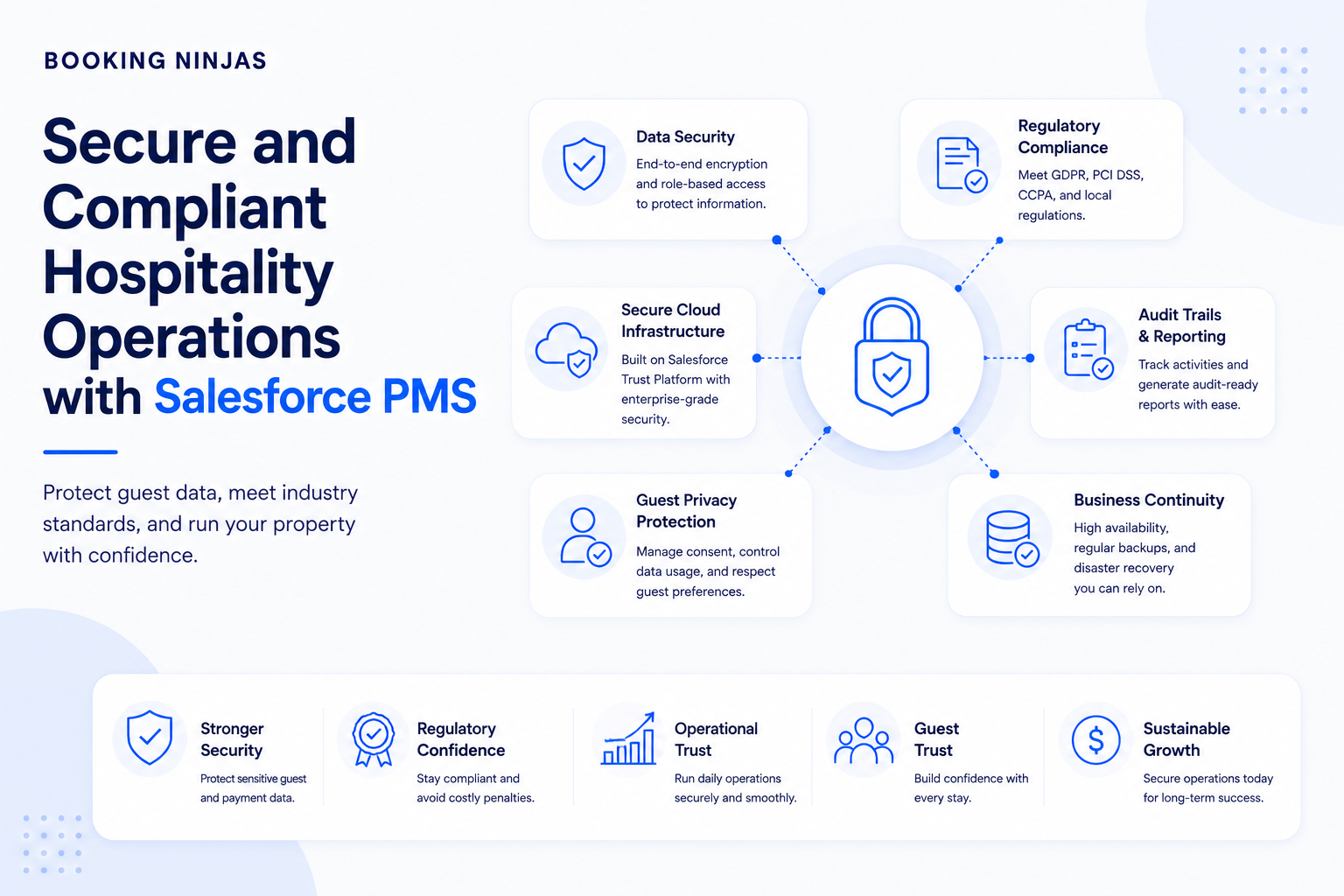
Property management systems can contain customer information, reservations, financial activity, contracts, operational records, user accounts, and other data that should not be equally accessible to every person or process.
Who is responsible for security in a Salesforce-based PMS?
Cloud security is a shared responsibility.
Salesforce provides and operates the underlying cloud platform and its foundational security architecture. The organization using the platform still determines how its users, permissions, data, integrations, devices, workflows, and configurations should be managed.
| Area | Platform contribution | Operator responsibility |
|---|---|---|
| Platform infrastructure | Salesforce operates and secures the underlying cloud platform. | Evaluate whether the platform and service model meet the organization's requirements. |
| User access | Identity, authentication, roles, permissions, and related access-control capabilities. | Decide who should have access and configure permissions appropriately. |
| Data | Platform controls for storing, accessing, and protecting information. | Decide what data is collected, retained, shared, and exposed to each user or integration. |
| Applications and workflows | Tools for permissions, automation, configuration, and governance. | Design and test workflows so sensitive actions are handled according to organizational policy. |
| Compliance | Security, audit, configuration, and governance capabilities that can support compliance requirements. | Determine applicable laws, policies, contracts, controls, documentation, and procedures. |
What security layers matter in property management?
Verify who is attempting to access the operating environment.
Determine which records, fields, functions, and actions that user is permitted to access.
Apply appropriate controls to sensitive data, documents, integrations, and workflows.
Monitor changes, review access, preserve appropriate audit information, and manage security over time.

How should a property management system control user access?
Authentication answers the first question: who is the user? Authorization answers the second: what should that user be allowed to do?
Salesforce supports multi-factor authentication and configurable access controls that allow administrators to structure access around user responsibilities.
In a property operation, different teams may need very different levels of access.
- Front desk and reservation staff
- Finance and accounting teams
- Housekeeping and operations
- Maintenance personnel
- Sales or account-management teams
- Property and portfolio managers
- System administrators
- External or temporary users where required
The security model should therefore follow the principle of giving users the access required to perform their work without exposing unrelated information simply because it exists in the same system.
What does granular permission management look like?
Security becomes more practical when access rules reflect the operating model rather than relying on a small number of overly broad user types.
| Role example | May require access to | May not require access to |
|---|---|---|
| Front desk | Reservations, arrival information, approved guest details, room status. | Full financial reporting or system administration. |
| Housekeeping | Assigned rooms, cleaning status, inspections, operational notes. | Unrelated customer financial information. |
| Maintenance | Work orders, assets, rooms, locations, task details. | Unrelated reservation or financial records. |
| Finance | Invoices, payments, balances, transactions, reconciliation. | Operational information that is not required for the financial workflow. |
| Administrator | System configuration appropriate to administrative responsibilities. | Access should still be governed, reviewed, and limited where appropriate. |
How should sensitive property data be protected?
Property-management environments can contain several categories of sensitive information, but those categories should not automatically be handled in exactly the same way.
- Customer or resident identity information
- Contact details
- Reservation and stay records
- Billing and transaction information
- Contracts and documents
- Operational and access records
- Employee information
- Other regulated or confidential data
Data protection should consider the sensitivity of the information, how it is used, who requires access, where it moves, how long it should be retained, and which security controls are appropriate.
Booking Ninjas uses Salesforce as its underlying platform, allowing operational records to use the broader Salesforce security, permission, governance, and data architecture.
Where does Salesforce Shield fit?
Organizations with additional security, audit, or data-protection requirements may evaluate Salesforce Shield capabilities.
Shield can include capabilities such as Platform Encryption, Event Monitoring, Field Audit Trail, and other security tools depending on the Salesforce products, edition, and licenses involved.
These capabilities should not be described as automatically enabled in every Salesforce or Booking Ninjas environment.
Booking Ninjas also provides a Salesforce Shield capability path for organizations whose security requirements call for these additional controls.
Why do auditability and monitoring matter?
Preventing unauthorized access is only one part of security. Organizations also need appropriate visibility into changes, activity, permissions, and exceptions.
Depending on the platform configuration and licensed capabilities, this can include information about:
- Changes to important records
- User and administrator activity
- Permission changes
- Data access patterns
- Policy or workflow exceptions
- Security-relevant events
Audit information can support investigation, internal governance, access reviews, operational controls, and certain compliance processes.
The existence of an audit log does not replace the need to decide what should be monitored, who should review it, and what response should occur when an issue is identified.
Does a Salesforce-native PMS make an organization compliant?
No. Regulatory compliance depends on much more than the software platform.
A property operator may need to consider privacy, payment, employment, financial, accessibility, housing, hospitality, or sector-specific requirements depending on its location and business model.
Technology can provide controls that support those requirements, but the organization still needs to determine which obligations apply and how its policies, procedures, contracts, users, integrations, retention rules, and operating practices should be designed.
| Compliance concern | Technology can support | Organization must determine |
|---|---|---|
| Privacy | Access controls, record management, workflows, auditability, data handling. | Legal basis, notices, consent requirements, retention, individual rights, and jurisdiction. |
| Access governance | Roles, permissions, authentication, monitoring, approval workflows. | Who should have access, why, for how long, and how access is reviewed. |
| Record retention | Structured records, history, workflows, and configurable retention processes. | Which records must be retained or deleted and for what period. |
| Payments | Connections to appropriate payment workflows and payment providers. | Payment architecture, provider responsibilities, scope, and applicable payment-security requirements. |
| Internal governance | Policies, approvals, audit records, dashboards, and structured workflows. | Which policies apply, who owns them, and how exceptions are handled. |
How can compliance requirements become operational workflows?
A policy is more useful when its requirements can be reflected in the work people actually perform.
Depending on the use case, organizations may need workflows for approvals, periodic reviews, acknowledgements, escalations, documentation, access changes, or other governance activity.
Booking Ninjas' Policy Management provides a Salesforce-native environment for creating, tracking, reviewing, and reporting on organizational policies and related governance workflows.
This can help connect policy records with operational processes, but the organization remains responsible for determining whether the policy itself meets its legal, regulatory, contractual, or internal requirements.
Where does zero-trust thinking fit?
A useful security model does not assume that a user should have broad access merely because they successfully entered the system.
Identity, role, conditions, permissions, data sensitivity, and the action being attempted can all matter when determining access.
Booking Ninjas' Zero Trust Security capabilities extend this governance approach around identity, access, monitoring, and security policy.
How do integrations change the security boundary?
Property operations rarely exist inside one application. Organizations may connect payment providers, accounting software, access-control systems, distribution platforms, communication applications, ERP systems, identity providers, or other services.
Every integration introduces questions about:
- Which data leaves each system
- Which system owns the resulting record
- How authentication is handled
- Which permissions the integration receives
- How credentials and secrets are managed
- What happens when the connection fails
- Which actions can be performed automatically
- Which activity should be logged or reviewed
Booking Ninjas supports external connections through its Integrations layer. The security model should consider both Booking Ninjas and the external applications participating in each data flow.
How should security change as a property portfolio grows?
Growth adds more than users. A larger organization may introduce additional properties, departments, legal entities, administrators, integrations, vendors, data jurisdictions, and operating policies.
The security model therefore needs to scale structurally.
For example, an organization may need to distinguish between access to:
- One property and the entire portfolio
- Local operations and corporate management
- Operational and financial records
- Standard and privileged administration
- Internal users and external partners
- Regional or business-unit data
Salesforce-native architecture provides a configurable platform for structuring these relationships, permissions, and workflows. Additional requirements still need to be designed and tested as the organization expands.
What should you evaluate before choosing a secure PMS?
- Identify sensitive information. Understand the customer, financial, operational, employee, contract, and other data the system will contain.
- Map user roles. Determine which teams require access to which records and functions.
- Define your compliance requirements. Identify relevant legal, regulatory, contractual, and internal obligations rather than assuming the software determines them.
- Review the platform security model. Understand authentication, permissions, governance, monitoring, encryption options, audit capabilities, and administrative controls.
- Review integrations. Include external systems and data flows in the security assessment.
- Plan ongoing governance. Define access reviews, configuration ownership, incident procedures, policy reviews, staff training, and monitoring after go-live.
How does Booking Ninjas use Salesforce for security and governance?
Booking Ninjas is a Salesforce-native platform for bookings and operations . Rather than maintaining property operations on an unrelated application layer, Booking Ninjas uses Salesforce as its broader platform foundation.
This allows reservations, customers, financial activity, workflows, operational records, reporting, and other configured processes to operate within the same broader environment as Salesforce identity, permissions, governance, automation, and security controls.
The Salesforce foundation is therefore part of the security architecture rather than simply an external CRM integration.
Connect bookings and operations with Salesforce permissions, governance, automation, reporting, and platform security.
Explore Salesforce →Add applicable encryption, monitoring, audit, and data protection capabilities where the required Salesforce licenses and configuration support them.
Explore Salesforce Shield →Connect policy creation, reviews, acknowledgements, governance, and reporting with operational workflows.
Explore Policy Management →Structure access and monitoring around identity, permissions, verification, and governance.
Explore Zero Trust Security →Connect external systems while defining the data, authentication, permissions, and workflows involved.
Explore Integrations →Apply the Salesforce-native operating model to reservations, guests, payments, property workflows, and reporting.
Explore Hospitality →Frequently asked questions
Is a Salesforce-native PMS automatically secure?
No platform makes an organization secure automatically. Salesforce provides an enterprise cloud security foundation and configurable security controls, while the organization remains responsible for areas such as users, permissions, data, configuration, integrations, devices, and operational security practices.
Does a Salesforce-native PMS automatically make a business GDPR or CCPA compliant?
No. Technology can provide controls that support privacy and compliance programs, but compliance depends on the organization's applicable legal requirements, data practices, configuration, policies, procedures, contracts, retention rules, user behavior, and ongoing governance.
Does Salesforce support multi-factor authentication?
Yes. Salesforce supports multi-factor authentication as part of its identity and access security model. The organization's authentication architecture and administration should still be configured according to its users and security requirements.
What is Salesforce Shield?
Salesforce Shield is a set of additional Salesforce security capabilities that can include Platform Encryption, Event Monitoring, Field Audit Trail, and related security tools. Availability depends on the Salesforce products, edition, licensing, and configuration involved.
Can different property-management users have different permissions?
Yes. Salesforce-native environments can use configurable roles and permissions to control access according to responsibilities such as reservations, operations, finance, management, or system administration. The exact permission model depends on the organization's configuration.
Is Booking Ninjas built on Salesforce?
Yes. Booking Ninjas is a Salesforce-native platform for bookings and operations, allowing operational records and workflows to use the broader Salesforce platform foundation for identity, permissions, governance, reporting, automation, and security.
Build security into the operating architecture
Connect bookings, customer data, financial records, permissions, workflows, integrations, and governance within a Salesforce-native operating environment.