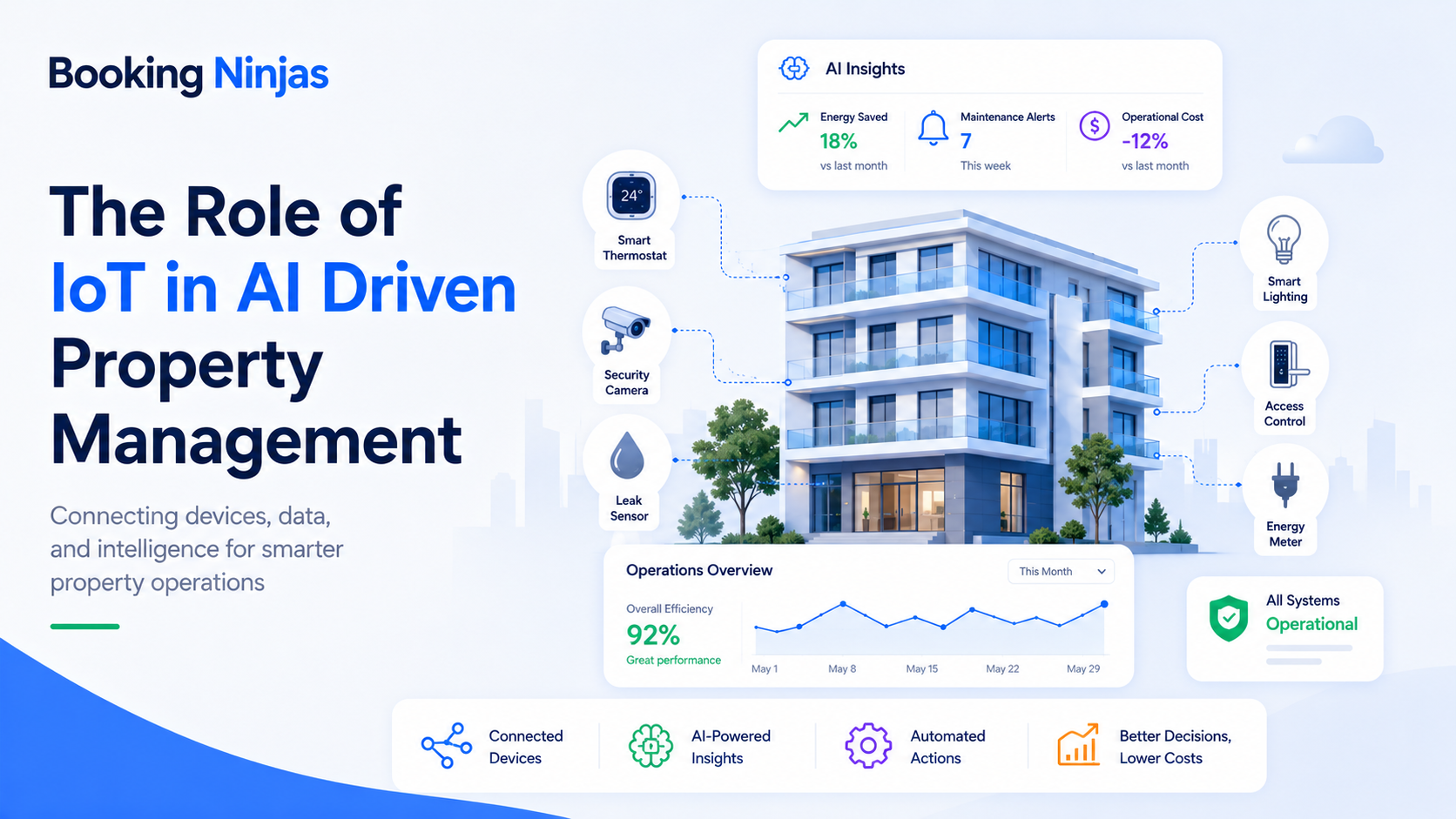
IoT and AI solve different parts of the property-management problem. IoT devices generate signals about physical spaces, equipment, access, environmental conditions, or usage. AI can help interpret patterns in that data. Operational software determines what should happen next.
A sensor alert by itself does not repair equipment, resolve a resident issue, change an access permission, or complete an inspection. The real value comes from connecting the physical event with the operational process responsible for responding to it.
What should property managers understand about IoT and AI?
- IoT collects or transmits information from connected physical devices and systems.
- AI can help identify patterns, classify information, forecast, summarize, or prioritize where suitable data exists.
- Automation is the execution layer that applies defined rules and workflows.
- A device alert becomes useful only when someone or some workflow is responsible for the next action.
- Integration quality matters because IoT, property, maintenance, access, and analytics systems may come from different vendors.
- Human review remains important for ambiguous, sensitive, safety-related, or high-impact decisions.
What is the difference between IoT, AI, and automation in property management?
The three concepts work together, but they should not be treated as interchangeable.
| Technology | Primary role | Property example |
|---|---|---|
| IoT | Generates, receives, or exchanges information from connected physical devices. | A device reports a condition, event, status, or measurement. |
| Automation | Executes a predefined response when configured conditions are met. | An event creates a maintenance request or notifies a responsible team. |
| AI | Interprets data to support classification, prediction, prioritization, summarization, or recommendations. | Historical equipment and work-order data helps identify a recurring pattern for review. |
| Human decision | Applies judgment where the appropriate response cannot be determined safely from a predefined rule. | A facilities manager decides whether unusual equipment behavior requires immediate shutdown, inspection, or continued monitoring. |

How should IoT data move through a property operation?
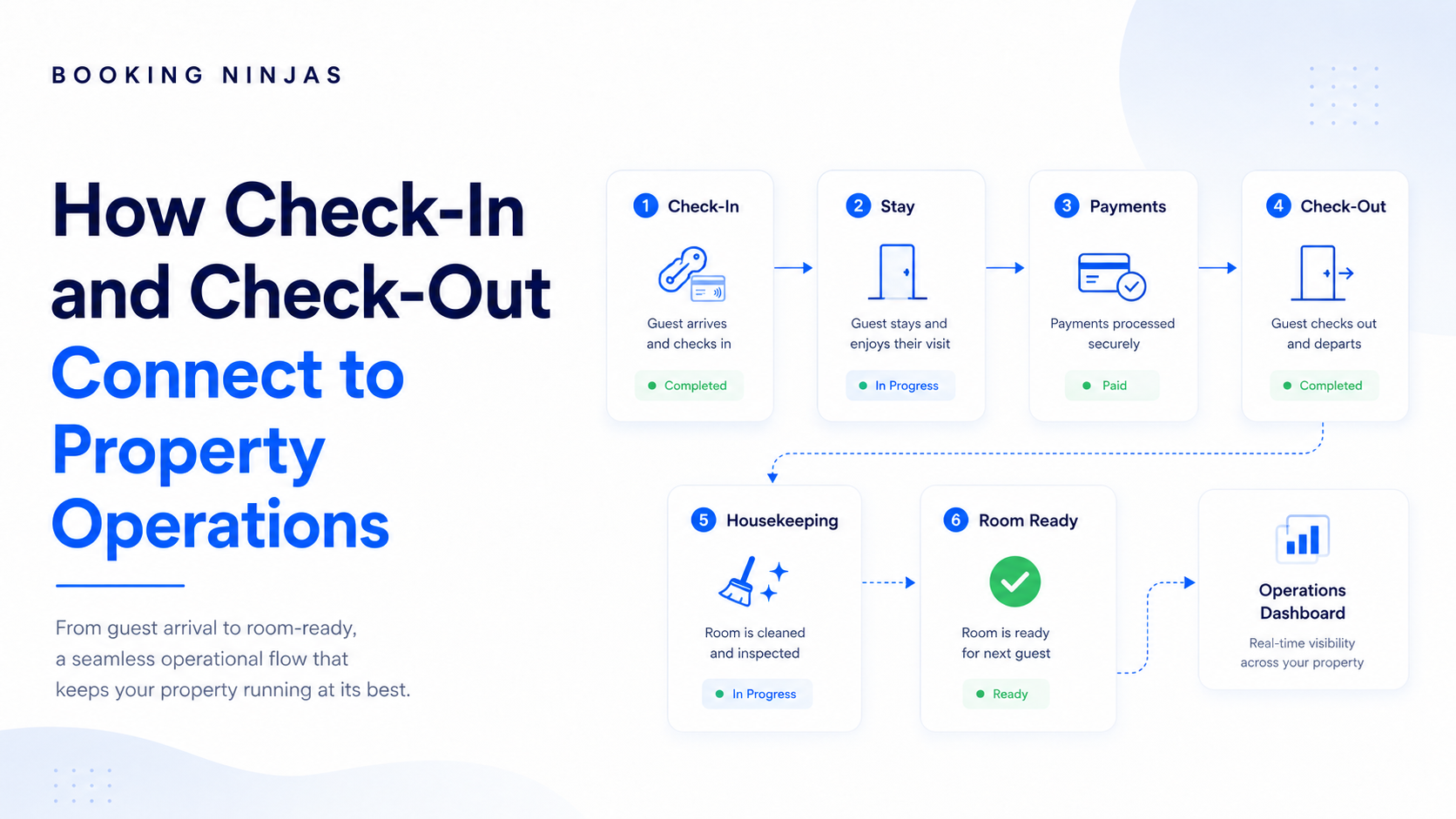
A connected device or external system generates a signal, reading, status, or event.
The event is linked with the relevant property, unit, asset, person, location, or operational record.
Rules, AI analysis, or human review determine what operational response is appropriate.
Tasks or work orders are completed and the resulting history becomes available for reporting and future analysis.
How do IoT devices connect with property management software?
IoT devices do not automatically become part of the property management system simply because both systems are connected to the internet.
The integration needs a defined way to exchange information. This can depend on:
- Device or vendor APIs
- Webhooks or event streams
- Middleware
- Authentication
- Data format
- Device identifiers
- Property and asset mapping
- Synchronization requirements
Booking Ninjas' API Integration layer can connect external platforms, access infrastructure, and IoT devices with Salesforce-based property and operational workflows.
Exact compatibility depends on the device vendor, available interfaces, security model, data structure, and implementation scope.
Why does IoT data need property context?
A reading is more useful when the system knows what the device relates to.
For example, an operational record may need to connect a device or event with:
- Property
- Building
- Floor
- Unit or room
- Shared area
- Equipment or asset
- Resident or authorized user relationship
- Existing maintenance history
Without that relationship, staff may receive an alert but still need to investigate where the device is, what it affects, who owns the response, and what happened previously.
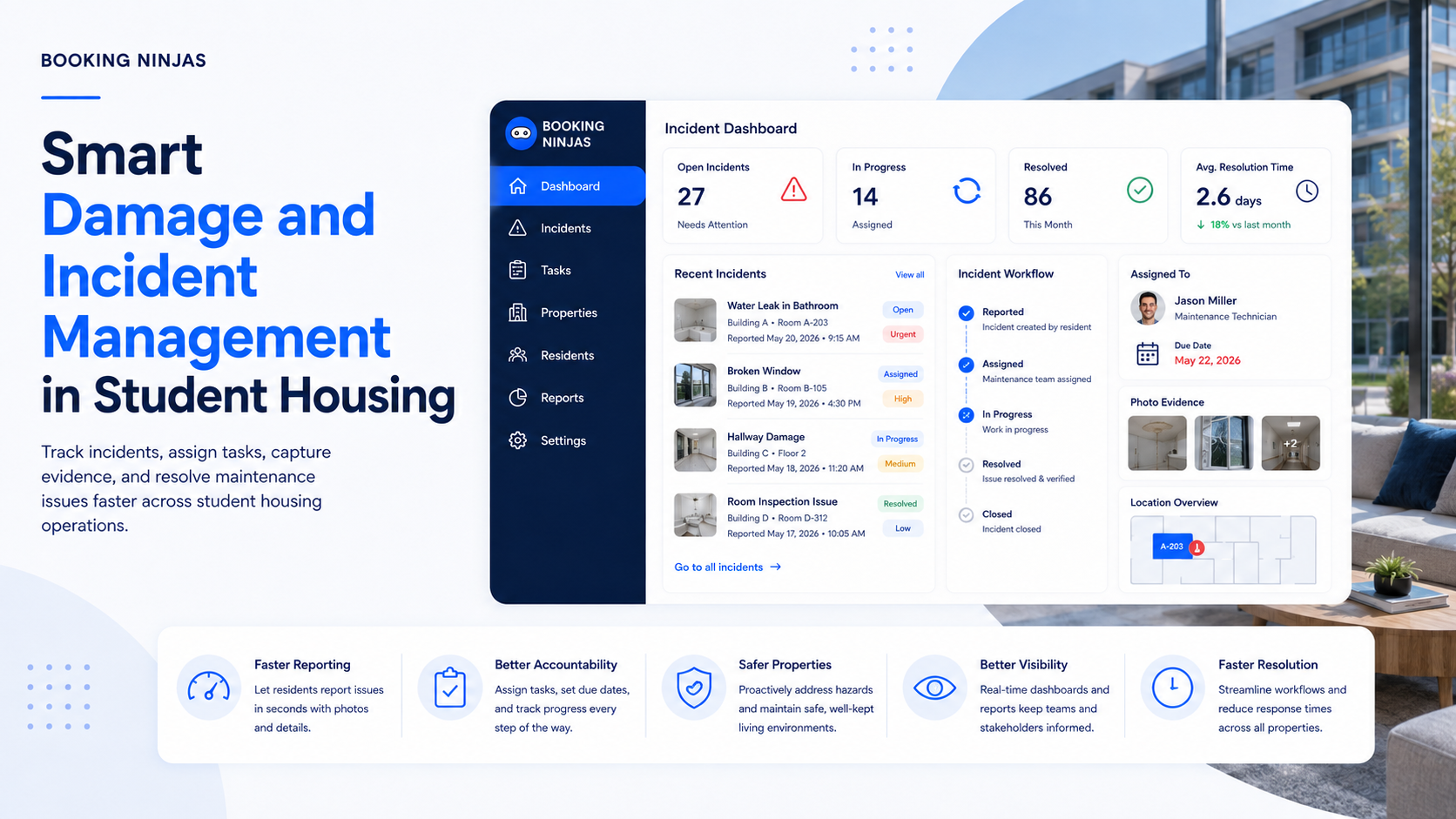
How can IoT and AI support property maintenance?
IoT can provide additional condition or event data around equipment. AI can help analyze patterns in that data together with maintenance history. The maintenance workflow still needs a structured way to create, assign, prioritize, execute, and close the resulting work.
A connected maintenance flow could look like:
- A device or connected system produces an event. The event contains the information available from the external device or platform.
- The system identifies the relevant asset or location. The event is associated with the operational record it affects.
- Rules determine the initial response. A defined threshold or event type may create a notification, request, inspection, or work order.
- AI can add analytical context. Where appropriate data exists, AI can help identify recurring patterns, summarize history, or flag items for closer review.
- Staff execute the maintenance workflow. The responsible employee or vendor investigates and records the actual action taken.
- The outcome becomes part of the asset history. Completed work can then support reporting and future analysis.
Booking Ninjas' Work Order Management provides the operational layer for creating, routing, assigning, tracking, escalating, and completing maintenance work inside Salesforce.
Where do energy and environmental systems fit?
Building systems can produce information about environmental or equipment conditions that property teams may want to incorporate into operational workflows.
Examples can include external systems associated with:
- Temperature
- Humidity
- Lighting
- HVAC equipment
- Water systems
- Energy consumption
- Equipment status
- Environmental alarms
The property-management platform does not need to replace every building-management system. Instead, relevant data or events can be connected where the external system exposes suitable interfaces and the integration is part of the implementation.
AI can then support analysis of historical patterns where sufficient data exists, but actual equipment control should follow the property's approved building-management and safety architecture.
How can connected access systems fit into property operations?
Access systems are another example of physical infrastructure that may need to respond to operational records.
Instead of maintaining property access independently, a connected workflow can relate access permissions to relevant people, properties, spaces, dates, roles, or approved operational conditions.
Booking Ninjas' Access Control can be integrated with physical and digital access infrastructure through APIs and workflow logic.
Access decisions should still be governed by approved permissions, security policies, identity controls, and the requirements of the connected hardware.
What should AI actually do with property and IoT data?
AI is most useful when it answers a defined operational question rather than being added simply because data exists.
| Operational question | AI can support | Human responsibility |
|---|---|---|
| Are similar issues recurring? | Pattern identification across device events and work history. | Determine whether the pattern requires operational change. |
| Which items deserve attention first? | Prioritization or risk signals based on available data. | Confirm the appropriate operational priority. |
| What has happened with this asset? | Summarization of structured maintenance or operational history. | Validate relevant facts before consequential action. |
| Is a process becoming delayed? | Detection of workflow patterns or potential bottlenecks. | Decide how the process or staffing response should change. |
| What may happen next? | Forecasting or predictive analysis where sufficient historical data exists. | Treat the result as a forecast rather than a certain future event. |
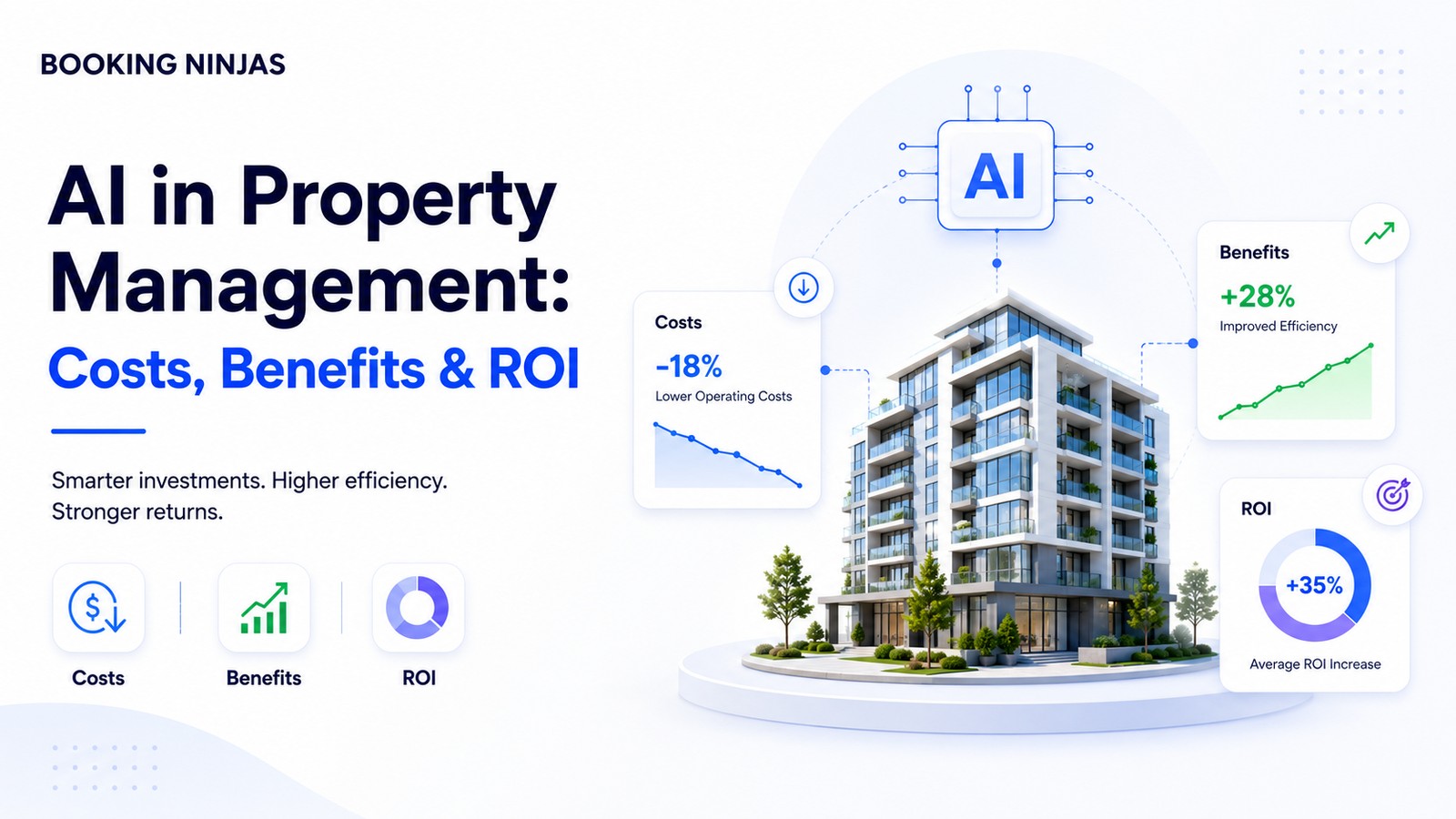
Booking Ninjas' AI layer connects predictive and generative capabilities with booking, operations, facilities, billing, and analytics workflows.
Why is workflow automation still necessary if AI is available?
AI and workflow automation solve different problems.
Once the organization knows the action that should follow a defined event, deterministic workflow rules are often the clearer execution mechanism.
A workflow may:
- Create a task
- Create a work order
- Assign an owner
- Send a notification
- Request approval
- Escalate overdue work
- Branch according to conditions
- Record completion
Booking Ninjas' Workflow & Process Management provides structured routing, assignments, approvals, escalation, branching logic, and downstream workflow execution.
What security questions should property managers ask before connecting IoT systems?
Every new connection creates another relationship between devices, networks, external platforms, APIs, property data, and users.
The implementation should clarify:
- How devices authenticate
- What information is exchanged
- Which systems can send or receive commands
- Who can access the resulting data
- How permissions are managed
- How events are logged
- What happens if connectivity fails
- Who owns incident response
Security is shared across the property organization, device providers, network infrastructure, connected applications, integrations, users, permissions, and operating procedures.
AI should also be given only the data and permissions appropriate to its defined use case.
Do property managers need to replace legacy systems before using IoT and AI?
Not necessarily.
An existing building, maintenance, access, or infrastructure system may remain responsible for its specialist function while relevant data is connected with the wider operational platform.
Booking Ninjas' Integrations environment supports API, middleware, and cross-system integration patterns for connecting external software with Salesforce-based property workflows.
Whether a legacy system should be integrated, modernized, or replaced depends on its interfaces, reliability, data model, security, strategic importance, and the scope of the broader implementation.
How should property managers measure whether an IoT or AI project is working?
Measure the operational problem the project was designed to improve rather than assuming that adding connected devices or AI creates a return by itself.
| Use case | Possible operational measures |
|---|---|
| Maintenance | Open work orders, repeat issues, response stages, completion history, asset-related exceptions. |
| Building monitoring | Event volume, unresolved alerts, repeated conditions, escalation patterns. |
| Workflow automation | Manual handoffs, waiting stages, overdue work, exceptions, failed workflow steps. |
| AI decision support | Recommendation usage, review rate, false positives, missed conditions, and user feedback. |
| Integration | Failed syncs, delayed events, unmatched records, unavailable devices, and data-quality issues. |
Booking Ninjas' Insights environment provides reporting and decision-support capabilities across operational, financial, and customer information.
How should a property manager introduce IoT and AI?
- Start with an operational problem. Define the maintenance, access, monitoring, service, energy, or workflow question that needs to be solved.
- Identify the physical data source. Determine which device or external system produces the relevant information.
- Map the property context. Connect the device or event with the appropriate property, space, asset, resident relationship, or operational record.
- Define the integration. Establish how data moves between the device platform and the property-management environment.
- Define the deterministic response. Decide which events should automatically create tasks, notifications, work orders, approvals, or other workflow actions.
- Add AI only where interpretation helps. Use AI for clearly defined analytical questions rather than replacing rules that already work.
- Define human review. Establish which conditions require staff judgment or escalation.
- Test failure scenarios. Include offline devices, duplicate events, missing data, inaccurate readings, failed integrations, and incorrect AI output.
- Measure the operational result. Compare the resulting workflow with the original problem and adjust the system based on evidence.
How can Booking Ninjas connect IoT, AI, and property operations?
Booking Ninjas is a Salesforce-native platform for bookings and operations . External IoT and building systems can be connected through the appropriate integration architecture, while Salesforce records provide the operational context around properties, people, assets, workflows, requests, and work.
AI can then support interpretation and decision support, while workflow automation, work orders, and staff remain responsible for executing the operational response.
Connect IoT devices, access infrastructure, external applications, and other systems with property records and workflows.
Explore API Integration →Add predictive, analytical, and generative decision support to connected operational data.
Explore AI →Turn maintenance needs into assigned, prioritized, trackable operational work.
Explore Work Order Management →Apply routing, approvals, assignments, notifications, escalation, and branching logic to operational events.
Explore Workflow & Process Management →Connect property records and workflow rules with supported physical and digital access infrastructure.
Explore Access Control →Analyze connected operational information through reporting and decision-support workflows.
Explore Insights →Connect Booking Ninjas with the wider technology environment through APIs, middleware, cloud, and other integration patterns.
Explore Integrations →Frequently asked questions
What is the difference between IoT and AI in property management?
IoT connects physical devices and systems so they can generate or exchange operational data. AI can analyze that data to support tasks such as classification, pattern detection, forecasting, prioritization, or summarization. They perform different roles and can be used independently or together.
Does IoT automatically automate property operations?
No. IoT provides device data or events. Automation requires rules and workflows that determine what should happen when a particular event occurs. The integration must also connect the device event with the relevant property or operational record.
Can IoT devices create maintenance work orders?
They can where the device platform, integration, and workflow are configured to do so. A supported device event can be connected to a rule that creates or routes maintenance work, while staff remain responsible for investigating and completing the work.
Can AI predict property maintenance problems?
AI can support predictive analysis when sufficient and relevant historical data is available. Predictions should be treated as decision support rather than guarantees that a particular failure will occur or be prevented.
Does Booking Ninjas connect with IoT devices?
Booking Ninjas supports API-based integration with IoT devices, access systems, and external platforms. Exact compatibility and functionality depend on the external device or platform, its available interfaces, and the implementation scope.
Do property managers need to replace legacy systems before using IoT?
Not necessarily. Existing building, access, maintenance, or other specialist systems can remain in place where suitable APIs, middleware, or other integration methods allow the required data and events to connect with the wider property-management workflow.
Should AI automatically act on every IoT alert?
No. Predictable low-risk responses can use configured automation, while ambiguous, sensitive, safety-related, or consequential situations may require human review. The appropriate boundary depends on the use case and operating policy.
Is Booking Ninjas built on Salesforce?
Yes. Booking Ninjas is a Salesforce-native platform for bookings and operations, allowing connected device events, property records, workflows, work orders, reporting, permissions, and integrations to use the broader Salesforce platform foundation.
Connect physical property data to operational action
See how Booking Ninjas can connect external systems, IoT data, Salesforce records, AI, maintenance workflows, and operational automation around the way your properties actually work.