
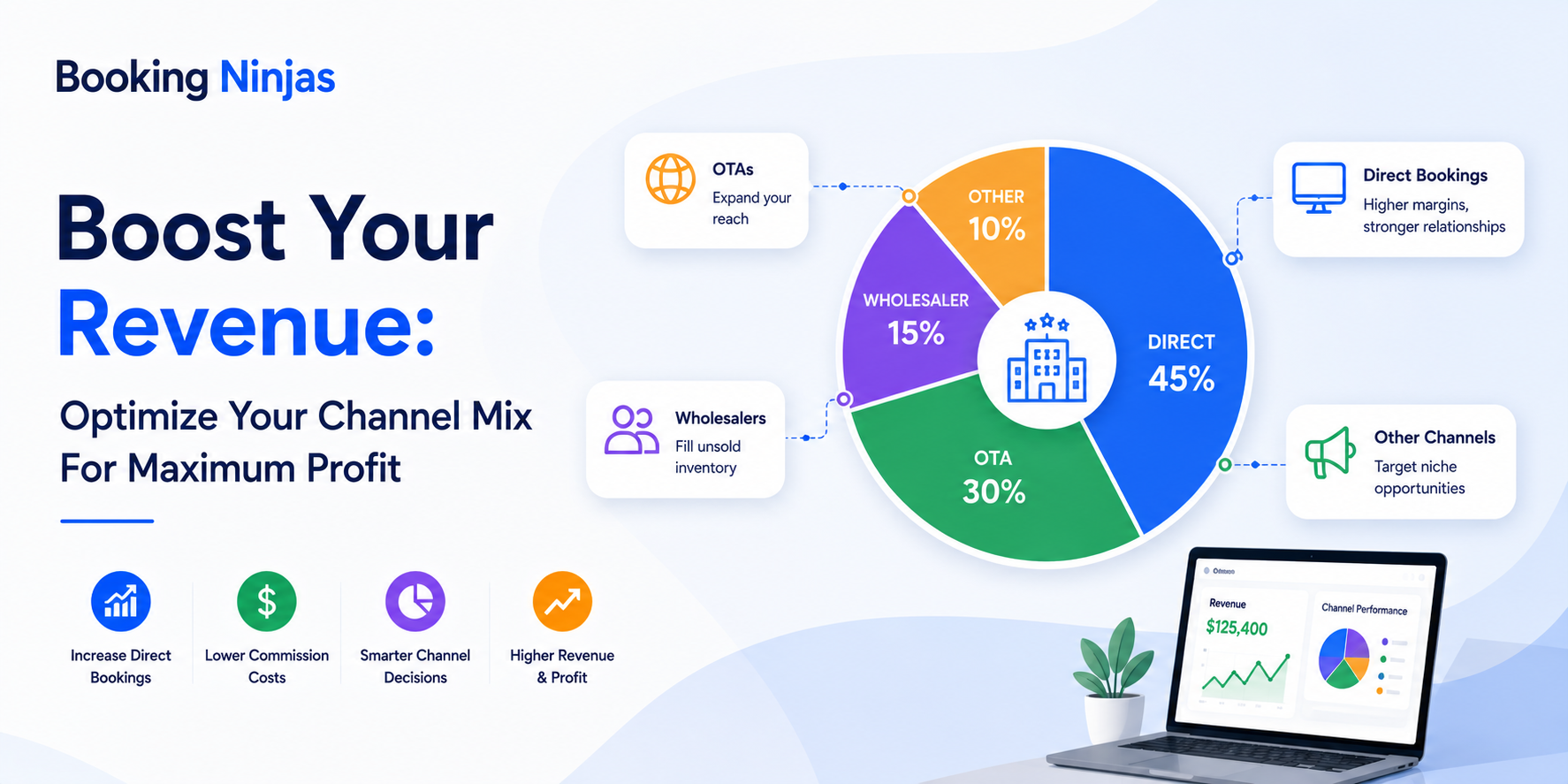
A hotel's distribution channel mix determines where its rooms are offered for sale and how bookings from those channels return to the property operation. Managing that mix requires more than adding listings to more websites.
OTAs, direct booking, corporate or agency distribution, metasearch, and other channels can perform different commercial roles. The right mix depends on the property's market, technology, agreements, inventory, customer acquisition strategy, and revenue objectives.
What is a hotel distribution channel mix?
A distribution channel mix is the combination of sales channels through which a hotel makes its inventory available to potential guests.
Depending on the property, these can include:
- Hotel website or direct booking engine
- Online travel agencies
- Travel agents
- Corporate booking arrangements
- Global distribution systems where used
- Tour operators or wholesalers
- Metasearch or referral channels
- Other contracted distribution partners
These channels do not necessarily have the same acquisition cost, rate rules, cancellation patterns, customer relationships, booking windows, stay lengths, or operational requirements.
What is the difference between channel management and channel-mix optimization?
| Function | Main question | Typical responsibility |
|---|---|---|
| Channel management | How do connected channels receive current rates and availability and return reservation activity? | Distribution synchronization and booking data flow. |
| Rate management | What price should apply for a date, room, rate plan, or defined condition? | Pricing rules, seasons, thresholds, and rate controls. |
| Availability management | Which inventory can still be sold? | Capacity, restrictions, blocks, and current sellable inventory. |
| Channel-mix optimization | Which channels should contribute which types of bookings under the property's commercial strategy? | Performance analysis, distribution economics, channel role, and allocation decisions. |
Booking Ninjas' Channel Manager connects rates, availability, and reservation activity across supported OTAs and booking channels.
The channel manager provides the distribution infrastructure. Deciding whether the resulting channel mix is commercially appropriate remains a revenue-management decision.
What does a connected distribution workflow look like?
Define rooms, capacity, restrictions, and the availability that can actually be sold.
Send applicable availability and rates to supported direct or external booking channels.
Reservations return to the operating environment and affect remaining availability.
Compare booking, pricing, revenue, cost, and behavior by channel before changing the distribution strategy.
Why must every distribution channel start from the same inventory logic?
A room distributed through an OTA and the same room offered through a direct channel are not two separate physical rooms.
The distribution architecture therefore needs a reliable relationship between:
- Physical rooms or units
- Room types
- Existing reservations
- Blocked inventory
- Capacity rules
- Blackout or restricted dates
- Reservation changes
- Cancellations
Booking Ninjas' Availability Management connects availability with booking activity, capacity controls, restrictions, blackout periods, usage rules, and controlled overrides.
That availability can then feed the distribution process instead of requiring staff to maintain unrelated inventory calendars.
Why should reservations from different channels return to one booking record?
Distribution is only useful operationally when the resulting reservation becomes part of the property's booking lifecycle.
The reservation record may need to preserve:
- Guest
- Arrival and departure dates
- Room or room type
- Booking source
- Rate or rate plan
- Reservation status
- Modifications
- Cancellations
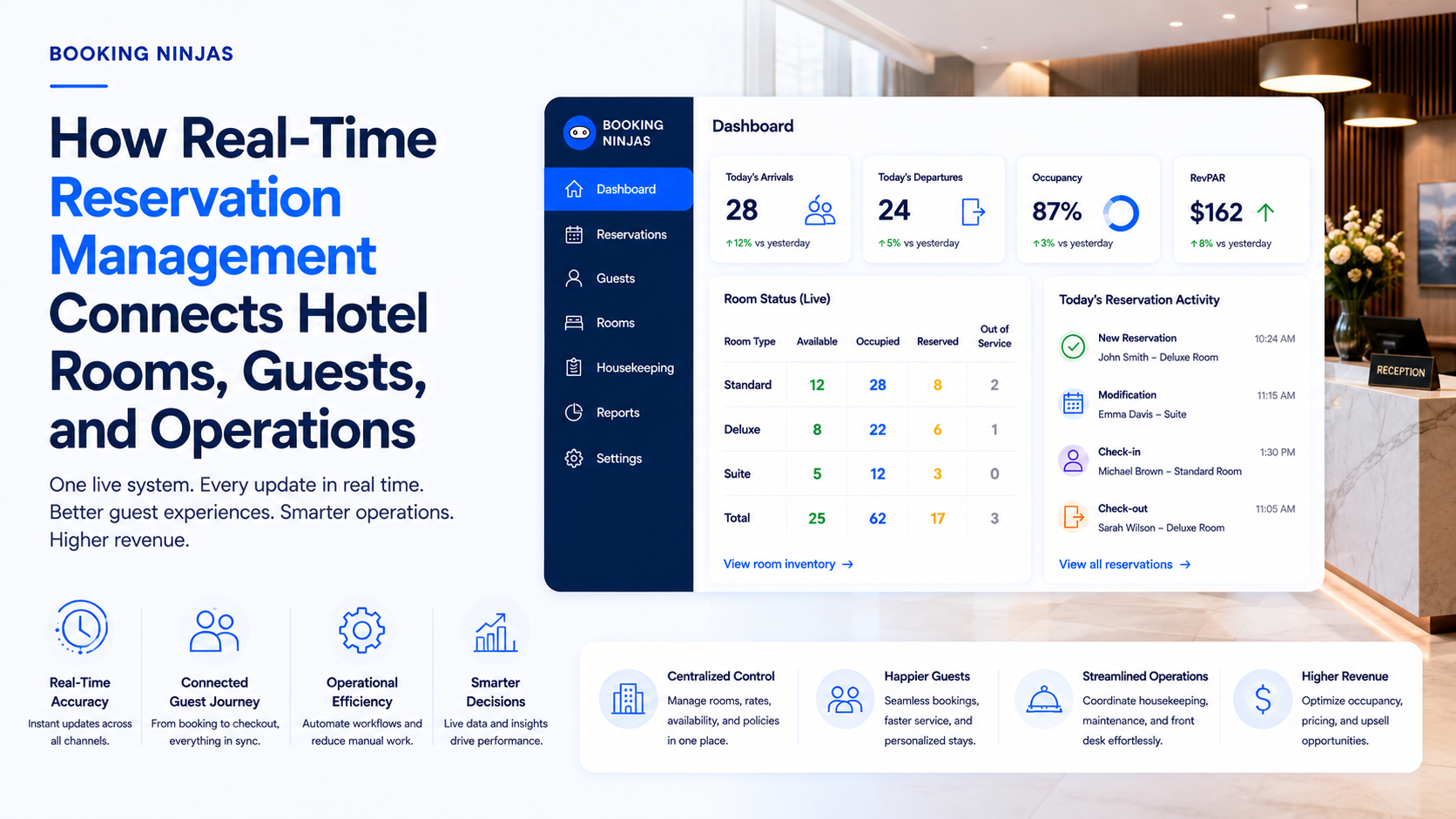
Booking Ninjas' Reservation Management centralizes reservation creation, updates, changes, cancellations, policies, availability effects, and reservation history within Salesforce.
How should rate management connect with distribution channels?
Distribution determines where inventory is offered. Rate management determines which price applies under the property's configured pricing strategy.
Pricing rules may consider:
- Season
- Date range
- Room or resource
- Demand conditions
- Current availability
- Occupancy or capacity threshold
- Time to arrival
- Defined business rules
Booking Ninjas' Rate Management supports seasonal pricing, multiple calendars, demand and availability conditions, capacity thresholds, time-to-booking conditions, pricing boundaries, and governed rate changes.
Rate strategy and channel strategy should therefore be coordinated, but they should not be treated as the same function.
Are direct bookings always better than OTA bookings?
Not necessarily.
Direct and third-party channels can have different economics and strategic roles.
| Factor | Direct booking | Third-party distribution |
|---|---|---|
| Customer acquisition | Property may fund website, search, advertising, CRM, or other acquisition activity. | Distribution partner provides marketplace reach according to its commercial model. |
| Distribution cost | May include marketing, booking technology, payment, loyalty, and operating costs. | May include commission, connectivity, participation, or other contracted costs. |
| Customer relationship | Property generally controls more of the direct booking journey and first-party relationship. | Relationship and available customer data can depend on the channel and its terms. |
| Reach | Depends on the property's own demand-generation capability. | Can provide access to established marketplace demand. |
| Commercial value | Should be evaluated from actual booking behavior, revenue, cost, customer relationship, and strategic role rather than channel label alone. | |
This is why “increase direct bookings” and “remove OTAs” should not automatically be treated as the same strategy. A property may decide that different channels serve different acquisition needs.
Why is booking revenue alone not enough to compare channels?
Gross booking revenue shows how much accommodation revenue was associated with a channel, but it does not necessarily show the economic contribution of that booking source.
Depending on the channel and the property's accounting model, comparison may need to consider:
- Gross booking revenue
- Channel commission
- Distribution fees
- Marketing or advertising expense
- Payment-processing cost
- Discounts or promotional cost
- Cancellation or refund behavior
- Other attributable acquisition costs
Which metrics help evaluate a hotel's distribution channel mix?
| Metric | What it helps explain |
|---|---|
| Reservation volume | How many bookings originate from the channel. |
| Room nights | How much inventory the resulting reservations consume. |
| Average rate | The accommodation rate achieved across booked room nights. |
| Gross revenue | Revenue attributed to reservations from the channel before relevant distribution costs. |
| Distribution cost | Commercial cost attributable to acquiring or processing bookings through that channel. |
| Booking lead time | How far before arrival guests from the channel tend to book. |
| Length of stay | How many room nights channel reservations typically consume. |
| Cancellation behavior | How frequently or how late reservations from the channel change or cancel. |
| Channel share | How much of booking or revenue activity depends on a particular source. |
| Net contribution measure | A property-defined view of revenue after the channel costs it chooses to attribute. |
The correct metric set depends on the property's objectives and accounting definitions. The important point is to compare channels consistently rather than declaring the highest-volume source the “best” channel.
What does a channel manager need to keep synchronized?
The purpose of channel connectivity is to reduce conflicting versions of sellable inventory and reservation information across supported distribution platforms.
The core relationships include:
- Availability sent to channels
- Rates sent to channels
- Reservations received
- Reservation changes
- Cancellations
- Remaining availability
- Booking source
- Channel-level performance data
Booking Ninjas Channel Manager provides centralized OTA distribution within Salesforce and supports channel-level visibility into booking volume, revenue contribution, occupancy, and inventory allocation.
Exact external-channel availability and connectivity still depend on the channel, interfaces, contracts, configuration, and implementation involved.
Where does GDS fit into a distribution strategy?
A Global Distribution System can form part of the distribution architecture for properties that sell through travel agencies, corporate travel environments, or other intermediary networks.
It should be evaluated in the same way as other distribution components:
- Which inventory is distributed
- Which rates are available
- Which market or booking use case it serves
- What commercial terms apply
- How reservations enter the PMS
- How changes and cancellations return
- How channel performance is measured
- Which system or integration manages the connection
A property should confirm GDS support against the specific distribution provider and implementation rather than assuming every PMS or channel-manager connection includes every GDS workflow.
How does customer and booking segmentation help explain channel performance?
Channel performance can vary because the bookings arriving through each source are not necessarily identical.
Useful operational segmentation may include:
- Booking source
- Property or location
- Room type
- Rate plan
- Length of stay
- Booking lead time
- Travel or account segment where defined
- New versus returning customer relationship
The objective is to understand the commercial behavior associated with different booking sources, not to assume that one channel always attracts a particular type of guest.
How should direct booking fit into the same distribution architecture?
The hotel website should not need its own disconnected version of room inventory and reservation status.
A direct booking flow should use the property's current availability, applicable rates, booking rules, and reservation workflow.
Booking Ninjas' Booking Engine operates on the same Salesforce-based booking environment, connecting booking creation with availability, configurable rules, confirmations, cancellations, workflows, and reporting.
This makes direct booking another distribution path into the reservation lifecycle rather than a separate inventory silo.
How should channel performance connect with revenue optimization?
Distribution decisions should create a feedback loop.
- Distribute inventory
- Apply rate strategy
- Receive reservations
- Track channel source
- Record resulting revenue
- Account for relevant channel economics
- Compare booking behavior
- Adjust distribution or pricing where appropriate
Booking Ninjas' Revenue Optimization provides analysis around revenue drivers, pricing performance, segments, locations, trends, discounts, and forecasting information inside Salesforce.
The broader Insights environment provides reporting across operational, customer, and financial information.
What role can AI play in channel-mix decisions?
AI can support analysis where sufficient relevant reservation, pricing, availability, and revenue data exists.
Potential applications include:
- Demand pattern detection
- Booking-pace analysis
- Pricing analysis
- Forecasting support
- Channel performance pattern detection
- Anomaly identification
AI should not be treated as proof that a particular channel, inventory allocation, or rate will maximize profitability. Operators still need defined commercial rules, reliable cost data, and human review of significant distribution decisions.
How should a hotel optimize its distribution channel mix?
- Map the current distribution channels. Identify the direct booking engine, OTAs, agency or corporate distribution, GDS relationships, wholesalers, and other channels currently receiving inventory.
- Define the inventory source. Make sure every connected channel ultimately reflects the property's controlled availability rather than an unrelated inventory list.
- Document rate rules. Define seasons, room types, rate plans, pricing boundaries, availability conditions, and other rules that affect distributed prices.
- Preserve booking source. Ensure reservations retain enough source information for channel-level analysis after they enter property operations.
- Define channel costs. Decide consistently which commissions, fees, marketing expenses, or other acquisition costs will be attributed when comparing channels.
- Compare booking behavior. Analyze room nights, achieved rate, lead time, length of stay, cancellations, revenue, and other relevant characteristics.
- Review channel dependence. Understand how much inventory or revenue depends on individual sources and whether that concentration matches the property's strategy.
- Adjust deliberately. Change rates, availability, channel participation, promotions, or inventory rules according to defined objectives rather than reacting to one metric.
- Measure the next result. Continue comparing booking and revenue outcomes after each material change to the distribution strategy.
How does Booking Ninjas connect hotel distribution and revenue management?
Booking Ninjas is a Salesforce-native platform for bookings and operations . Availability, rates, reservations, distribution activity, customer records, and reporting can therefore remain connected within the wider Salesforce environment.
The distribution strategy itself remains a business decision. The platform provides the operational records and controls needed to distribute supported inventory, manage reservations, analyze channel activity, govern rates, and review resulting performance.
Synchronize rates, availability, and reservations across supported OTAs and booking channels while preserving channel-level activity.
Explore Channel Manager →Control seasonal, dynamic, and rule-driven pricing across properties, resources, calendars, and defined conditions.
Explore Rate Management →Keep sellable inventory connected with bookings, restrictions, capacity, blocks, and controlled overrides.
Explore Availability Management →Centralize reservations, changes, cancellations, policies, availability effects, and booking history.
Explore Reservation Management →Connect direct booking activity with current availability, rates, booking rules, confirmations, and reservation records.
Explore Booking Engine →Analyze revenue drivers, pricing performance, segments, locations, trends, and forecasting information.
Explore Revenue Optimization →Report across connected booking, customer, operational, and financial data within Salesforce.
Explore Insights →Frequently asked questions
What is a hotel distribution channel mix?
A hotel distribution channel mix is the combination of direct and third-party channels through which the property makes room inventory available for booking. Depending on the property, this can include a direct booking engine, OTAs, travel agencies, corporate distribution, GDS connections, wholesalers, metasearch, and other booking partners.
What is the difference between a channel manager and channel-mix optimization?
A channel manager provides the technical connection that keeps rates, availability, and reservations synchronized across supported booking channels. Channel-mix optimization evaluates how those channels contribute according to booking behavior, distribution cost, revenue, customer relationship, inventory strategy, and the property's commercial objectives.
Are direct bookings always more profitable than OTA bookings?
Not necessarily. Direct bookings may avoid some third-party commissions but can still involve website, marketing, payment, technology, loyalty, and acquisition costs. OTA bookings have different commercial costs and can provide marketplace reach. Channels should be compared using consistent revenue and cost definitions.
Can hotel rates differ across distribution strategies?
Rate structures can vary according to configured rate plans, seasons, dates, availability, demand conditions, contractual arrangements, and other permitted business rules. The hotel should also account for any commercial or contractual requirements that apply to a particular distribution partner.
Does a hotel need a channel manager to use several OTAs?
A hotel can manage channels individually, but a channel manager can centralize supported OTA distribution so availability, rates, and reservation activity do not have to be maintained separately on every connected platform.
Does Booking Ninjas support hotel channel management?
Yes. Booking Ninjas Channel Manager synchronizes rates, availability, and reservations across supported OTAs and booking platforms and provides channel-level visibility inside Salesforce. Exact external-channel connectivity depends on the supported integration and implementation.
Can AI optimize a hotel's distribution channel mix automatically?
AI can support demand analysis, booking-pattern detection, forecasting, pricing analysis, and identification of performance trends where relevant data exists. It should not be treated as a guarantee that a particular channel allocation or pricing decision will maximize profitability.
Is Booking Ninjas built on Salesforce?
Yes. Booking Ninjas is Salesforce-native, allowing hotel reservations, rates, availability, channel activity, customer records, workflows, reporting, automation, and integrations to use the broader Salesforce platform foundation.
Connect hotel distribution to the revenue picture behind it
See how Booking Ninjas can connect channel distribution, direct bookings, availability, rates, reservations, customer records, and revenue reporting within one Salesforce-native environment.




.jpg)
