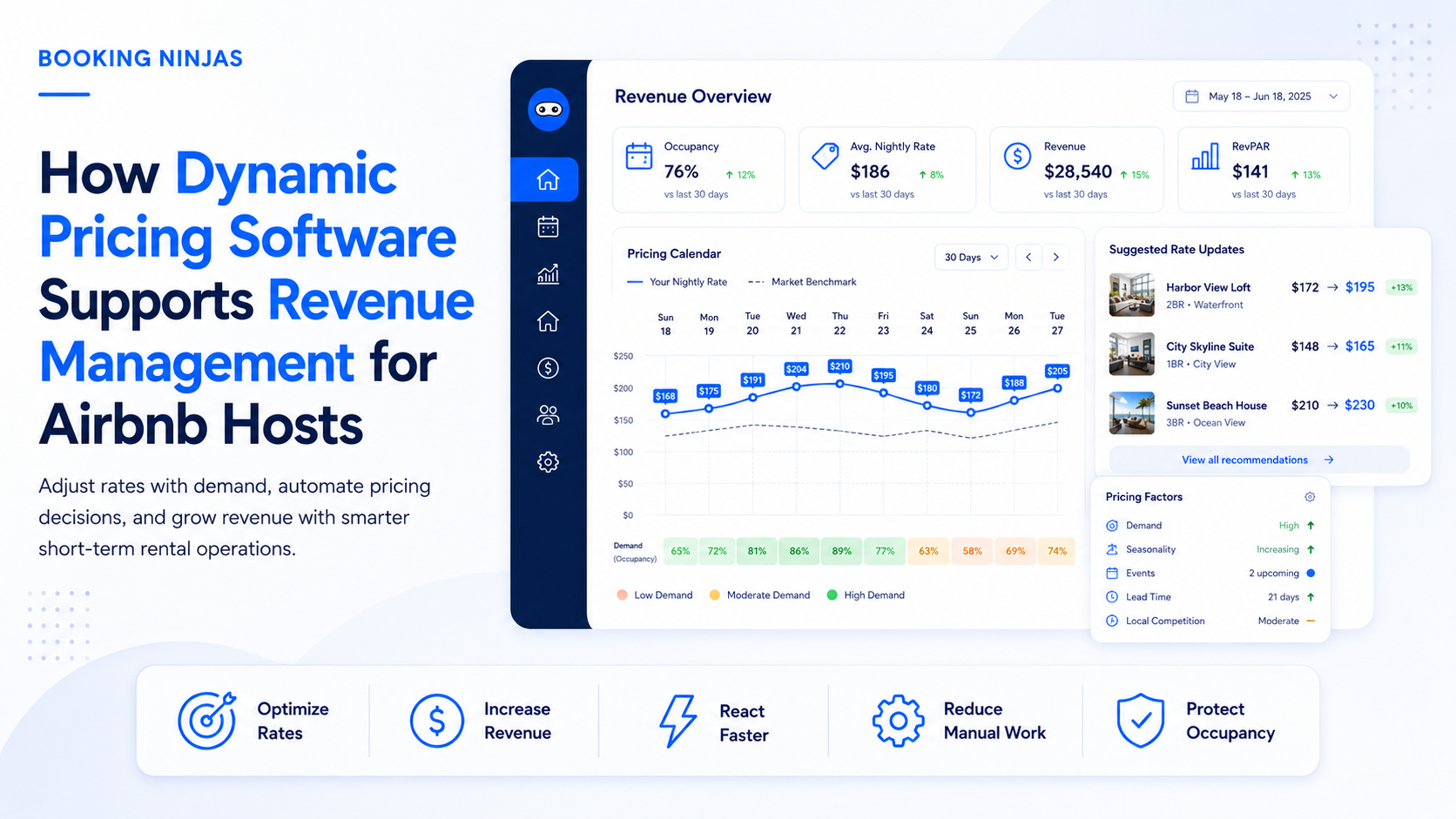
Short-term rental pricing changes with the booking date, stay date, remaining availability, season, demand patterns, property characteristics, and the operator's own revenue strategy.
The purpose is not to find one permanently "correct" nightly rate. It is to create a repeatable pricing process that can respond to changing conditions while remaining inside the operator's commercial rules.
What is dynamic pricing for Airbnb properties?
Dynamic pricing is a method of changing rates according to defined conditions rather than keeping the same price for every available night.
Those conditions can include internal information such as availability, occupancy, booking pace, season, time until arrival, or property-specific rules. External market information can also be incorporated where the pricing system has access to an appropriate data source or integration.
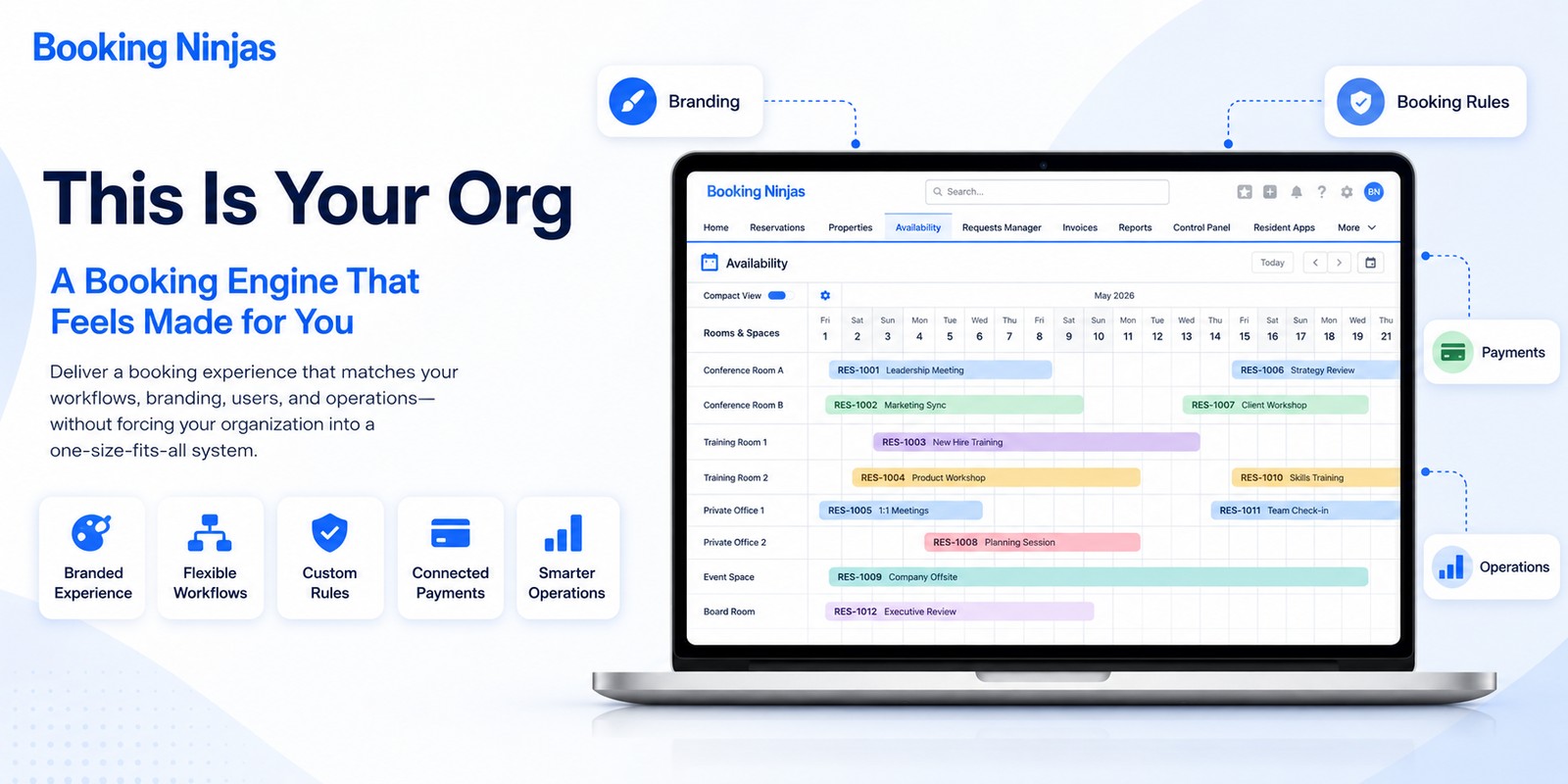
Booking Ninjas' Rate Management supports seasonal and dynamic pricing, minimum and maximum rates, overrides, demand and availability conditions, occupancy or capacity thresholds, time-to-booking logic, and custom business rules.
What is the difference between static and dynamic pricing?
| Pricing approach | How rates change | Main limitation or consideration |
|---|---|---|
| Static pricing | Rates remain fixed until someone manually changes them. | The price may not reflect important changes in availability, booking pace, season, or demand. |
| Seasonal pricing | Predetermined rates apply during defined seasons or date ranges. | Useful for predictable patterns but may not react to changes occurring inside the season. |
| Rule-based dynamic pricing | Rates change when predefined conditions or thresholds are met. | Rules need appropriate boundaries, testing, and monitoring. |
| AI-supported pricing | Analytical models identify patterns, forecast conditions, or support rate recommendations and automated decisions. | Output still depends on available data, configuration, assumptions, and the operator's pricing strategy. |
Which signals can influence a short-term rental rate?
The appropriate inputs depend on the property, market, available data, and pricing system.
- Current property availability
- Portfolio occupancy
- Booking pace or booking velocity
- Time remaining before check-in
- Day of week
- Seasonal periods
- Length-of-stay conditions
- Existing reservations
- Property or unit characteristics
- Operator-defined minimum and maximum rates
- Connected market or demand signals where available
- Other custom business rules
Not every pricing engine has access to every possible signal. Operators should distinguish information generated by their own booking system from external market information supplied by another source.
How should dynamic pricing connect with the booking workflow?
Availability, reservations, dates, booking pace, and relevant property information provide pricing context.
Rules, thresholds, analytical models, and operator-defined boundaries determine the appropriate rate action.
Approved rates can be applied to direct booking and connected external channels according to the distribution setup.
Reservation and revenue data can be reviewed to determine whether the pricing strategy should change.
Why should dynamic pricing connect to availability?
The value of a particular night is partly influenced by how much inventory remains available and how close that date is to arrival.
Booking Ninjas' Availability Management provides the availability and inventory context behind booking decisions.
Pricing rules can then respond to applicable availability, occupancy, capacity, or booking conditions without maintaining a completely separate view of what can still be sold.
Low remaining availability may affect pricing
An operator may choose rules that treat limited remaining inventory differently from periods with substantial availability.
Unbooked near-term nights may require a different strategy
As arrival approaches, an operator may decide that an unbooked night should follow different pricing rules from a night several months away.
Neither approach guarantees the night will sell or that one rate will produce more revenue than another.
Which pricing rules should Airbnb managers control?
Dynamic pricing should operate within the commercial boundaries of the business rather than changing rates without constraints.
- Minimum nightly rates
- Maximum nightly rates
- Seasonal pricing periods
- Weekend or weekday rules
- Time-to-arrival thresholds
- Occupancy or availability thresholds
- Length-of-stay conditions
- Promotional or discount boundaries
- Property-specific overrides
- Approval requirements
Booking Ninjas Rate Management allows operators to define pricing boundaries, seasonal overrides, dynamic thresholds, custom business rules, and role-based controls.
This is important because pricing automation should execute the operator's strategy rather than quietly replacing it.
What are common dynamic pricing scenarios?
| Situation | Possible pricing response | What should still be reviewed |
|---|---|---|
| High-demand period | Apply a higher rate or different threshold within configured boundaries. | Remaining availability, booking pace, minimum stays, and wider market context. |
| Slow booking period | Evaluate a lower rate, promotion, or other configured pricing action. | Whether price is actually the reason demand is lower. |
| Last-minute availability | Apply a time-to-arrival rule within the permitted rate range. | Cleaning, turnover, operational cost, and probability of booking. |
| Gap between reservations | Adjust rate or stay restrictions to make the gap easier to book where appropriate. | Length-of-stay rules and operational feasibility. |
| Extended stay | Apply an approved length-of-stay pricing structure or discount. | Total booking value, availability displacement, fees, and operating model. |
Where does AI fit into dynamic pricing?
AI can support the analytical layer of pricing by examining booking, availability, pricing, and demand information for patterns that would be difficult to evaluate manually at scale.
Depending on the available data and configured workflow, AI can support:
- Demand-pattern identification
- Booking-pace analysis
- Pricing-window recommendations
- Occupancy forecasting
- Pricing anomaly detection
- Revenue forecasting
Booking Ninjas' AI capabilities can work across booking and revenue information, while Rate Management provides the pricing rules and controls that govern how rates are applied.
Should Airbnb hosts automate every rate change?
Not necessarily.
The appropriate level of automation depends on the maturity of the pricing strategy, quality of the data, property characteristics, market conditions, and the consequences of an incorrect rate.
Operators can use automation for predictable scenarios while retaining manual review or approval for exceptions.
Examples of situations that may deserve additional review include:
- Major local events
- New properties without meaningful history
- Unusually long stays
- Premium or highly distinctive properties
- Significant market disruptions
- Rates approaching minimum or maximum boundaries
How do dynamic rates reach Airbnb and other booking channels?
Creating a rate is only one part of distribution. If a property is sold through Airbnb, other OTAs, and direct channels, the applicable rate also needs to reach the correct listing and dates.
Booking Ninjas' Channel Manager connects rates, availability, and reservations across supported booking channels.
That creates a clearer relationship between the pricing decision and the actual inventory being distributed.
Do rates need to be identical on every booking channel?
Not necessarily.
A short-term rental operator may have different commercial arrangements, promotions, fees, restrictions, or rate plans across direct and third-party booking channels.
The important requirement is that those differences are intentional and that the correct rate logic is mapped to the correct inventory and channel.
Pricing consistency should therefore mean consistency with the operator's distribution strategy—not automatically the same visible number everywhere.
How does dynamic pricing change for multi-property Airbnb managers?
Portfolio management creates a larger pricing problem because the operator may be controlling many properties, unit types, calendars, seasons, and booking channels simultaneously.
A centralized pricing model can provide common rules while still allowing individual properties to retain their own pricing boundaries and exceptions.
Booking Ninjas' Airbnb Property solution supports multi-property and short-term rental operations with centralized reservations, availability, occupancy, reporting, and operational visibility.
Rate Management can then apply seasonal and dynamic pricing across multiple calendars and properties while preserving property-level controls.
Why should pricing be treated as a feedback loop?
The pricing process should not end when a new rate is published.

A useful pricing workflow compares what the operator expected with what happened after the rate was applied.
If booking pace, occupancy, or revenue performance differs from the assumptions behind the strategy, the rules can be reviewed rather than simply allowing the same automation to continue indefinitely.
Which metrics should Airbnb managers use to evaluate pricing?
No single metric can tell an operator whether a pricing strategy is working.
| Measure | What it can show | Context to retain |
|---|---|---|
| Occupancy | How much available inventory was booked. | Property, dates, season, availability, restrictions. |
| Average booked rate | The average rate associated with completed or relevant reservations. | Property, channel, date range, stay length. |
| Booking pace | How quickly future dates are being reserved. | Lead time, season, property, historical comparison. |
| Revenue by available period | How pricing and occupancy combine across available nights or other relevant inventory periods. | Availability, revenue recognition, cancellations, fees. |
| Channel performance | How booking activity differs across distribution sources. | Channel costs, booking value, cancellation behavior, stay characteristics. |
Booking Ninjas' Revenue Optimization provides revenue analytics, pricing-performance analysis, forecasting, and related decision support within the broader operating platform.
Does dynamic pricing guarantee more Airbnb revenue?
No.
Dynamic pricing can help operators respond to changing conditions more systematically, but financial performance still depends on factors outside the pricing engine.
- Market demand
- Property quality and location
- Listing visibility
- Available inventory
- Reviews and reputation
- Competition
- Distribution strategy
- Fees and operating costs
- Cancellation behavior
- The quality of the pricing rules themselves
Can Airbnb managers keep an external pricing tool?
Yes. An operator may already use a specialist revenue-management or pricing platform that fits its strategy.
In that case, the architectural question is whether the pricing output can connect reliably with the PMS, availability, reservations, and booking channels.
Booking Ninjas supports external system connections through its Integrations layer.
The exact integration depends on the external pricing system, available interfaces, data ownership, rate structure, required workflows, and implementation scope.
Should dynamic pricing live inside the PMS or in a separate system?
Either architecture can work.
| Architecture | Potential advantage | What to evaluate |
|---|---|---|
| Pricing inside the operating platform | Rate rules can use the same booking, availability, workflow, permission, and reporting foundation. | Whether the native pricing capabilities meet the operator's required strategy and data needs. |
| External pricing system | Allows the operator to retain a specialist pricing engine or existing workflow. | Integration, rate mapping, update timing, data exchange, error handling, and ownership of pricing logic. |
The important requirement is that pricing remains connected to the real inventory and reservations affected by each rate decision.
How should an Airbnb host implement dynamic pricing?
- Define the pricing objective. Decide which business question the pricing strategy is intended to address instead of starting with automation for its own sake.
- Review the available data. Identify which reservation, availability, occupancy, historical, market, and property information is actually available.
- Set pricing boundaries. Establish minimum and maximum rates, seasons, thresholds, restrictions, overrides, and approval rules.
- Start with understandable logic. Test the pricing rules on a manageable portion of inventory before expanding automation across the portfolio.
- Connect distribution. Confirm that approved rates reach the correct property, dates, and booking channels.
- Review outcomes. Compare bookings, rates, occupancy, revenue, and exceptions against the original pricing assumptions and refine the strategy.
Why does Salesforce-native pricing architecture matter?
Pricing decisions depend on relationships between properties, calendars, availability, reservations, customers, channels, rules, financial records, and reporting.
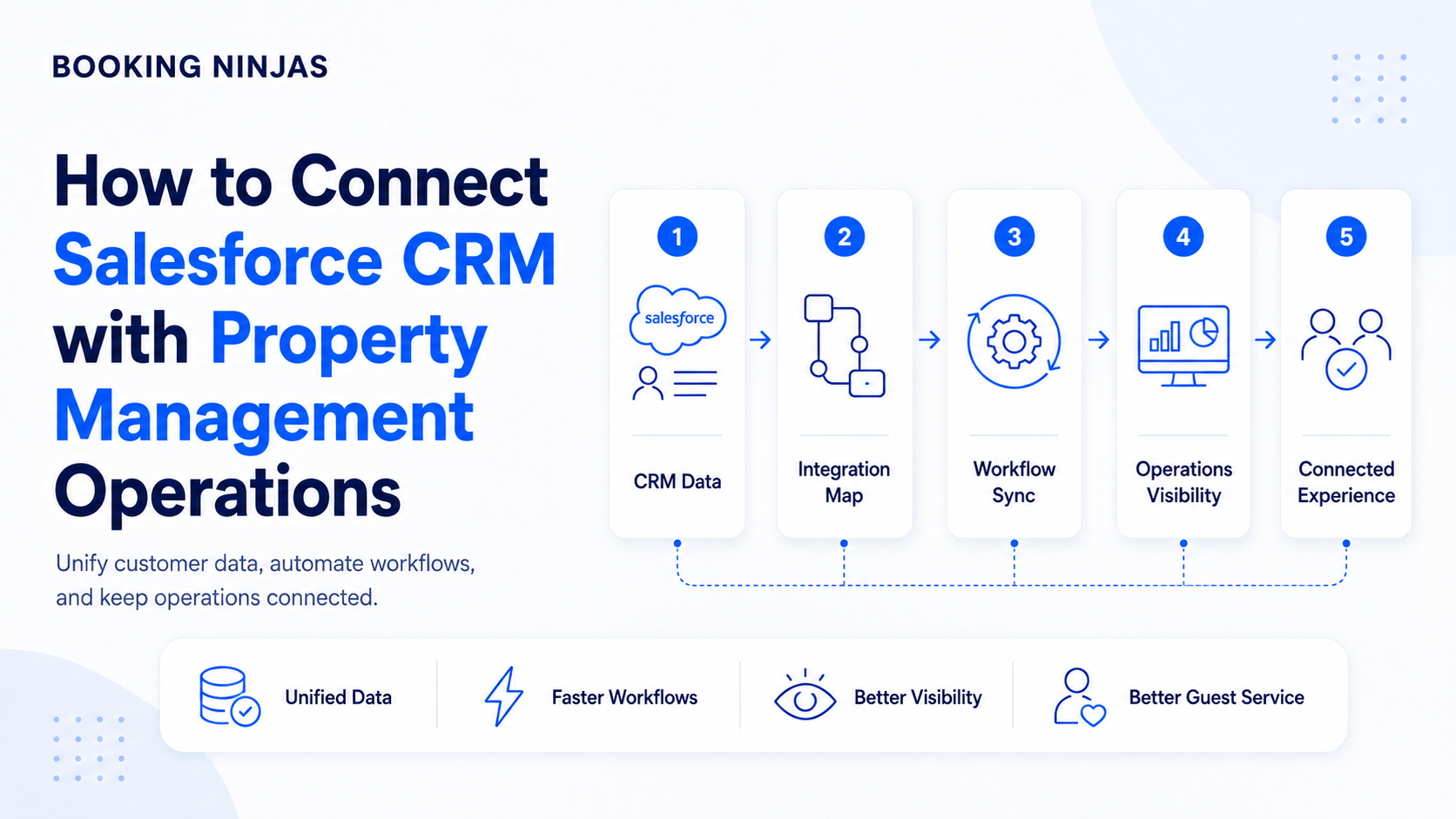
Booking Ninjas runs its booking and rate-management environment on Salesforce, allowing pricing to operate within the same broader platform foundation as reservations, workflows, permissions, automation, reporting, and integrations.
The Salesforce-native foundation can therefore preserve more of the operational context around a pricing decision.
How does Booking Ninjas support Airbnb dynamic pricing?
Booking Ninjas is a Salesforce-native platform for bookings and operations . Its Airbnb Property environment connects short-term rental inventory, reservations, availability, rates, channels, operations, and reporting within the same broader platform architecture.
Dynamic pricing can therefore remain connected to the booking lifecycle rather than operating only as a separate pricing spreadsheet or disconnected rate tool.
Manage short-term rental properties, listings, reservations, availability, occupancy, and portfolio operations.
Explore Airbnb Properties →Control seasonal rates, dynamic thresholds, pricing rules, boundaries, overrides, and multi-calendar pricing.
Explore Rate Management →Connect rates with the inventory, dates, occupancy, and availability conditions behind each booking period.
Explore Availability Management →Distribute relevant rates, availability, and reservations across Airbnb and other supported booking channels.
Explore Channel Manager →Analyze pricing performance, revenue drivers, trends, forecasting, and related financial information.
Explore Revenue Optimization →Apply predictive analysis and decision support to relevant booking, demand, pricing, and revenue workflows.
Explore AI →Frequently asked questions
What is dynamic pricing for Airbnb?
Dynamic pricing is a method of adjusting short-term rental rates as relevant conditions change. Pricing rules can use information such as availability, occupancy, season, booking pace, time to arrival, property characteristics, and other configured signals.
Does dynamic pricing guarantee more Airbnb revenue?
No. Dynamic pricing can help operators respond more systematically to changing booking conditions, but revenue still depends on demand, property quality, availability, competition, distribution, operating strategy, costs, and how pricing rules are configured.
Does dynamic pricing require AI?
No. Dynamic pricing can use predefined rules and thresholds without AI. AI can add pattern detection, forecasting, recommendations, and other forms of decision support where the available data and configured workflow support them.
Should Airbnb hosts let software change every rate automatically?
Not necessarily. Operators can define minimum and maximum rates, seasonal rules, thresholds, overrides, approvals, and human review according to the property, market, pricing strategy, and level of automation they are comfortable using.
Can dynamic pricing connect with Airbnb and other booking channels?
Yes, where the pricing and distribution systems support the required connection. Booking Ninjas connects Rate Management with Channel Manager so relevant rates, availability, and reservations can remain aligned across supported booking channels.
Can Booking Ninjas work with an external pricing system?
Booking Ninjas supports integrations with external systems. The exact connection depends on the pricing platform, available APIs, required rate data, update logic, authentication, and implementation scope.
Does Booking Ninjas include dynamic rate management?
Yes. Booking Ninjas Rate Management supports seasonal and dynamic pricing, minimum and maximum rates, pricing thresholds, overrides, multi-calendar pricing, custom business rules, and AI-supported pricing analysis within its Salesforce-native booking platform.
Connect pricing to the booking lifecycle
Bring rates, availability, reservations, Airbnb distribution, pricing rules, AI analysis, and revenue reporting into a Salesforce-native operating environment.