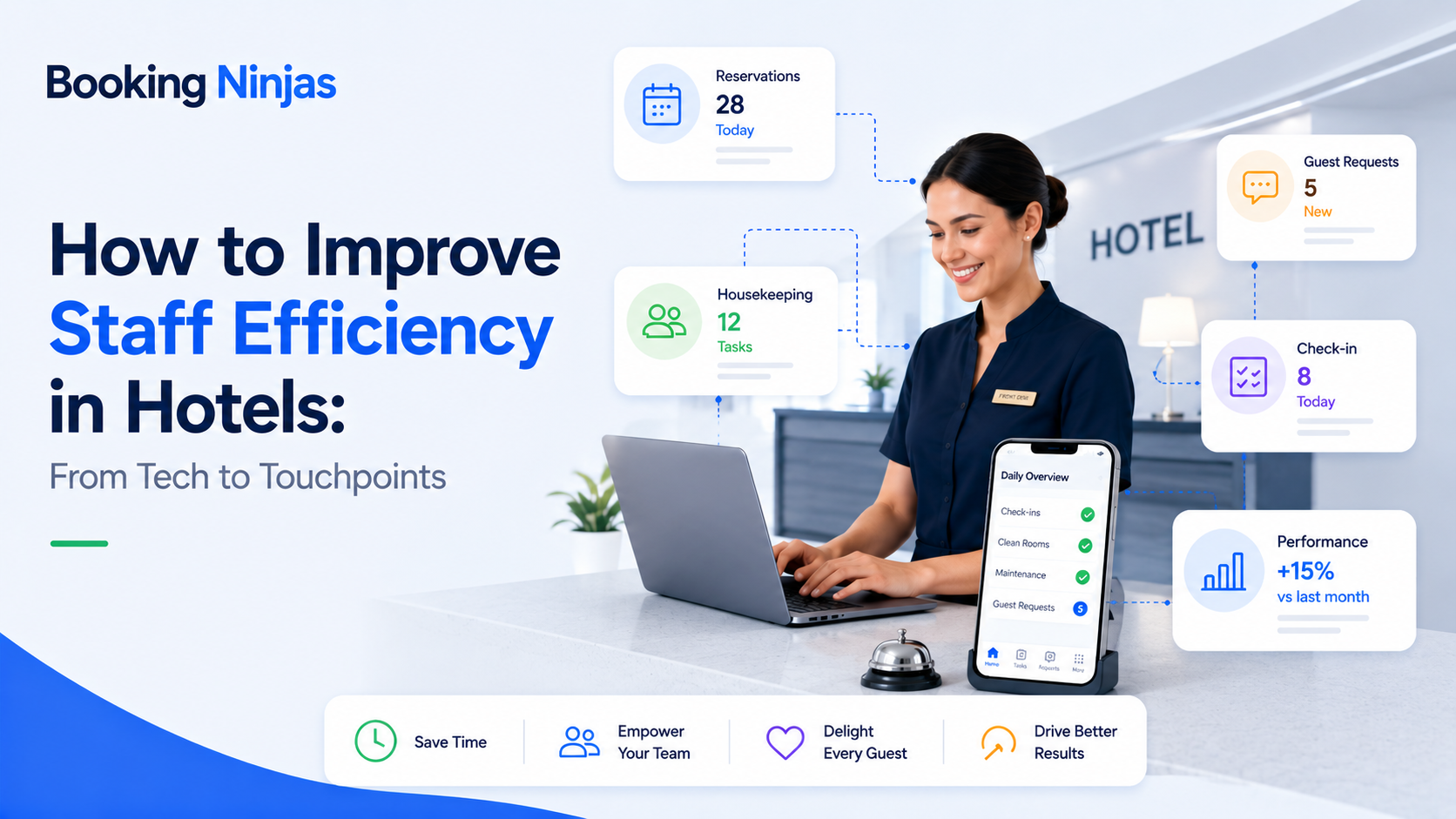
Improving hotel staff efficiency does not simply mean asking fewer employees to complete more work. It means reducing unnecessary coordination, duplicate entry, status chasing, unclear ownership, and repetitive tasks so staff can spend more of their working time on the activities that actually require them.
Technology should remove avoidable handoffs without removing the human judgment, hospitality, and exception handling that guests and daily hotel operations still need.
What does staff efficiency mean in hotel operations?
Hotel staff efficiency is the ability to complete the required work with clear ownership, timely information, appropriate tools, and as little unnecessary coordination as practical.
It is not the same as minimizing headcount.
An efficient hotel workflow should help staff answer:
- What needs to happen?
- Who owns the next action?
- How urgent is it?
- Which guest or room does it affect?
- What information is needed?
- What is the current status?
- What happens if it is delayed?
- What confirms completion?
Where does staff time get lost in a hotel?
Many delays are caused by the space between departments rather than by the individual task itself.
| Operational problem | What staff end up doing | Better operating model |
|---|---|---|
| Disconnected room status | Front desk contacts housekeeping to ask whether a room is ready. | Room-readiness status updates within the shared operational workflow. |
| Requests arrive everywhere | Staff search email, calls, chat, notes, or verbal messages to understand what is still open. | Structured request intake with ownership, status, priority, and escalation. |
| Maintenance communicated informally | Problems are passed between departments with incomplete context. | Work orders connected to the room, issue, owner, priority, and status. |
| Routine tasks are recreated manually | Staff repeatedly assign predictable work after the same operational event. | Rules trigger tasks, notifications, or workflows where the next action is known. |
| No shared operational status | Managers hold meetings or send messages simply to determine what is happening. | Shared dashboards and status records show open work, ownership, bottlenecks, and exceptions. |
What does a connected hotel workflow look like?
A booking, departure, guest request, room-status change, or issue creates an operational need.
The system creates or routes the appropriate request, task, work order, notification, or workflow.
The responsible staff member acts with the room, guest, priority, due time, and other relevant context available.
Status updates inform dependent teams and provide data for escalation, reporting, and process improvement.
Booking Ninjas' Operations environment provides the wider Salesforce-native layer for workforce coordination, requests, tasks, work orders, workflows, inspections, housekeeping, and operational control.
How should reservations trigger operational work?
A reservation is not only a front-desk record. Arrival, departure, extension, room change, and cancellation can all affect work in other departments.
For example, a departure may affect:
- Room occupancy status
- Housekeeping workload
- Room inspection
- Maintenance follow-up
- Inventory availability
- Front-desk readiness
Booking Ninjas' Check-In and Check-Out workflows can connect arrival and departure status with the wider booking and operational environment.
How can hotels improve housekeeping efficiency?
Housekeeping becomes easier to coordinate when cleaning work follows actual room and stay status.
Instead of relying on repeated phone calls or static lists, a structured workflow can connect:
- Guest departure
- Room status
- Cleaning task
- Assigned staff member
- Priority
- Inspection requirement
- Completion status
- Front-desk visibility
Booking Ninjas' current Operations suite includes Housekeeping Management for cleaning schedules, room-status tracking, assignments, inspections, readiness, and operational visibility.
The important efficiency gain comes from the connection between room status and the work—not from assuming every room should always follow the same cleaning sequence.
How should guest and internal requests move between hotel teams?
Staff should not need to manually determine ownership every time an ordinary request arrives.
A structured request record can capture:
- Guest or requester
- Room or location
- Request category
- Priority
- Assigned department
- Current owner
- Status
- Resolution history
Booking Ninjas' Request Management supports structured intake, prioritization, routing, ownership, status tracking, notifications, and escalation.
A towel request, housekeeping follow-up, maintenance concern, or another routine service request can therefore enter the appropriate workflow without remaining trapped in an inbox or verbal handoff.
When should hotel work become a task?
A task is useful when a specific action needs an owner, priority, due date, status, and completion record.
Booking Ninjas' Task Management supports task creation, assignment, prioritization, tracking, notifications, escalation, and reporting inside Salesforce.
Tasks can be connected with bookings, assets, or operational workflows so the employee completing the action does not need to reconstruct the context separately.
| Operational event | Possible task | Useful context |
|---|---|---|
| Departure recorded | Prepare room for turnover. | Room, departure status, priority, next arrival. |
| Guest request received | Deliver or resolve requested service. | Guest, room, request type, urgency. |
| Inspection fails | Complete corrective action. | Finding, location, responsible team, required follow-up. |
| Operational deadline approaches | Review or complete required step. | Due date, owner, process, escalation rule. |
How should maintenance work connect with hotel operations?
Maintenance efficiency improves when staff can see the issue, location, priority, responsibility, work status, and effect on hotel operations in the same process.
Booking Ninjas' Work Order Management supports maintenance and service work from creation and assignment through status tracking, escalation, completion, and historical reporting.
A work order may be connected to:
- Property
- Room or facility
- Reported issue
- Priority
- Assigned employee or team
- Operational impact
- Status
- Completion history
That makes it easier for housekeeping, front desk, maintenance, and management to work from the same operational status rather than maintaining independent interpretations of the problem.
Which hotel tasks should be automated?
Automate steps that are predictable, rule-driven, and low-risk enough to execute without requiring a new judgment each time.
Examples can include:
- Routing a request by category
- Assigning a defined task
- Sending a status notification
- Escalating overdue work
- Triggering an approval
- Creating a follow-up action
- Updating a workflow stage
- Recording completion
Booking Ninjas' Workflow & Process Management supports conditional routing, multi-step approvals, role-based assignments, escalation, branching logic, notifications, and downstream tasks.
Where can guest self-service reduce routine staff work?
Self-service is useful when guests can safely complete a predictable action without needing a staff member to re-enter the same information.
Booking Ninjas' Self-Service Kiosk supports configurable check-in workflows that can connect kiosk activity with booking and Salesforce records.
The Guest Portal can provide controlled guest access to booking details, permitted reservation changes, invoices, payments, documents, communication, and service requests.
Appropriate self-service can reduce the number of routine transactions staff must perform manually while keeping exceptions available for human handling.
Self-service should not replace staff when a situation involves an emergency, dispute, complex exception, accessibility need, sensitive conversation, or another interaction where human support is appropriate.
Which hotel touchpoints still need people?
The purpose of operational technology is not to make every guest interaction digital.
Human involvement remains especially useful when:
- The guest has an unusual request
- A service failure needs recovery
- A policy exception requires judgment
- A payment or reservation is disputed
- A safety concern needs immediate attention
- The guest needs additional assistance
- Several departments must coordinate an exception
- The interaction itself is part of the hospitality experience
How should scheduling connect with operational demand?
Scheduling decisions are stronger when managers can compare staffing requirements with actual and expected operational activity.
Useful context can include:
- Expected arrivals
- Expected departures
- Occupied rooms
- Housekeeping workload
- Open requests
- Open work orders
- Scheduled events or services
- Known staffing availability
Booking Ninjas' Operations environment currently includes workforce, staff, attendance, and shift-management capabilities alongside operational task and workflow management.
This does not mean staffing should be determined solely by an occupancy percentage. Different properties, service models, departments, employee skills, contracts, and operating conditions can require different coverage.
What should hotels measure to find operational bottlenecks?
Measure the workflow that is creating the problem rather than using a single generic “staff productivity” score.
| Operational question | Useful measures |
|---|---|
| Where is work waiting? | Open requests, tasks, work orders, overdue work, workflow age. |
| Where do handoffs slow down? | Time between creation, assignment, acceptance, action, and completion. |
| Are rooms becoming ready when needed? | Room status, cleaning status, inspection status, next arrival. |
| Which issues repeat? | Request categories, maintenance history, recurring room or asset problems. |
| Is workload concentrated? | Open assignments by team, person, location, category, and priority. |
| Where are exceptions increasing? | Escalations, reassigned work, failed workflows, disputed requests, corrective actions. |
Booking Ninjas' Insights environment provides reporting and decision-support capabilities across operational, financial, and customer data.
Where can AI support hotel staff efficiency?
AI can support staff efficiency when enough operational data exists for it to interpret patterns or assist with prioritization.
Depending on the implementation, useful applications can include:
- Identifying recurring bottlenecks
- Highlighting overdue-risk patterns
- Supporting workload analysis
- Classifying requests
- Summarizing operational activity
- Supporting demand forecasts
- Prioritizing items for review
- Surfacing unusual operational patterns
AI output should be treated as decision support where appropriate, particularly when staffing, service recovery, safety, or another consequential operational decision is involved.
How should a hotel improve staff efficiency step by step?
- Map a real daily workflow. Start with one process such as room turnover, guest requests, maintenance, arrival, or departure.
- Identify the operational trigger. Define what event creates the work and where that information originates.
- Define ownership. Establish which person, role, or department is responsible for each stage.
- Define the statuses and handoffs. Make it clear when work is new, assigned, in progress, blocked, completed, or escalated.
- Connect the relevant records. Make the guest, room, booking, request, asset, or payment context available where the employee needs it.
- Automate predictable coordination. Use rules for routing, assignments, notifications, approvals, and follow-up where the required action is clear.
- Define the human exceptions. Decide which situations should stop automation and move to a person for review.
- Train by workflow and role. Teach employees how their own work moves through the process rather than showing every feature in the software.
- Measure the workflow after launch. Review waiting work, bottlenecks, repeated issues, handoff delays, exceptions, and user feedback before changing the process again.
How does Booking Ninjas connect hotel staff workflows?
Booking Ninjas is a Salesforce-native platform for bookings and operations . Its hospitality environment can connect reservations, guests, payments, housekeeping, requests, maintenance, tasks, workflows, and reporting within the broader Salesforce platform.
The practical objective is to keep operational context attached to the work as it moves between hotel teams.
Connect reservations, guests, payments, housekeeping, daily operations, and reporting across hospitality workflows.
Explore Hospitality →Coordinate workforce, requests, tasks, maintenance, inspections, workflow execution, and operational visibility.
Explore Operations →Capture, prioritize, route, assign, track, and escalate guest or operational requests.
Explore Request Management →Create and assign operational actions with ownership, priority, deadlines, status, and completion history.
Explore Task Management →Manage maintenance and service work from creation through assignment, execution, escalation, and completion.
Explore Work Order Management →Connect routing, approvals, assignments, notifications, escalation, branching logic, and downstream operational work.
Explore Workflow & Process Management →Give guests controlled access to bookings, payments, communication, documents, and configured service requests.
Explore Guest Portal →Review operational, customer, and financial information through connected reporting and decision-support workflows.
Explore Insights →Frequently asked questions
How can hotels improve staff efficiency?
Hotels can improve staff efficiency by reducing duplicate entry, unclear ownership, manual status checks, disconnected requests, repetitive task assignment, and unnecessary handoffs. Technology is most useful when it connects operational events with the people and workflows responsible for the next action.
Does hotel automation mean reducing staff?
No. Automation can reduce repetitive coordination and administrative work, but staffing needs depend on the property's service model, occupancy, workload, roles, operating hours, and guest requirements. Automation should support staff rather than being treated as an automatic headcount-reduction formula.
How can technology improve housekeeping efficiency?
Technology can connect guest departures, room status, cleaning assignments, inspections, completion status, and front-desk visibility so housekeeping work follows current operating conditions rather than relying on separate lists and repeated manual updates.
Can hotel guest requests be routed automatically?
Yes, where routing rules are configured. Booking Ninjas Request Management can assign requests according to factors such as category, priority, role, or department and can trigger notifications, escalation, approvals, and follow-up workflows.
Should every hotel task be automated?
No. Predictable and rule-driven coordination is usually a stronger candidate for automation than unusual, sensitive, disputed, or high-impact situations. Hotels should define where automation stops and human review begins.
Can guest self-service reduce front-desk work?
Self-service can reduce staff involvement in appropriate routine activities such as configured check-in steps, reservation access, payments, documents, and service requests. Staff should remain available for exceptions, assistance, disputes, safety concerns, and interactions that benefit from human service.
Can AI improve hotel staff efficiency?
AI can support pattern detection, classification, forecasting, prioritization, summarization, and workload analysis when relevant operational data is available. It should be treated as decision support rather than a guarantee of lower labor costs or better service outcomes.
Is Booking Ninjas built on Salesforce?
Yes. Booking Ninjas is a Salesforce-native platform for bookings and operations, allowing hotel reservations, operational tasks, workflows, customer records, reporting, permissions, automation, and integrations to use the broader Salesforce platform foundation.
Improve the handoffs, not just the individual tasks
See how Booking Ninjas can connect reservations, housekeeping, guest requests, maintenance, tasks, self-service, and hotel workflows in a Salesforce-native operational environment.